
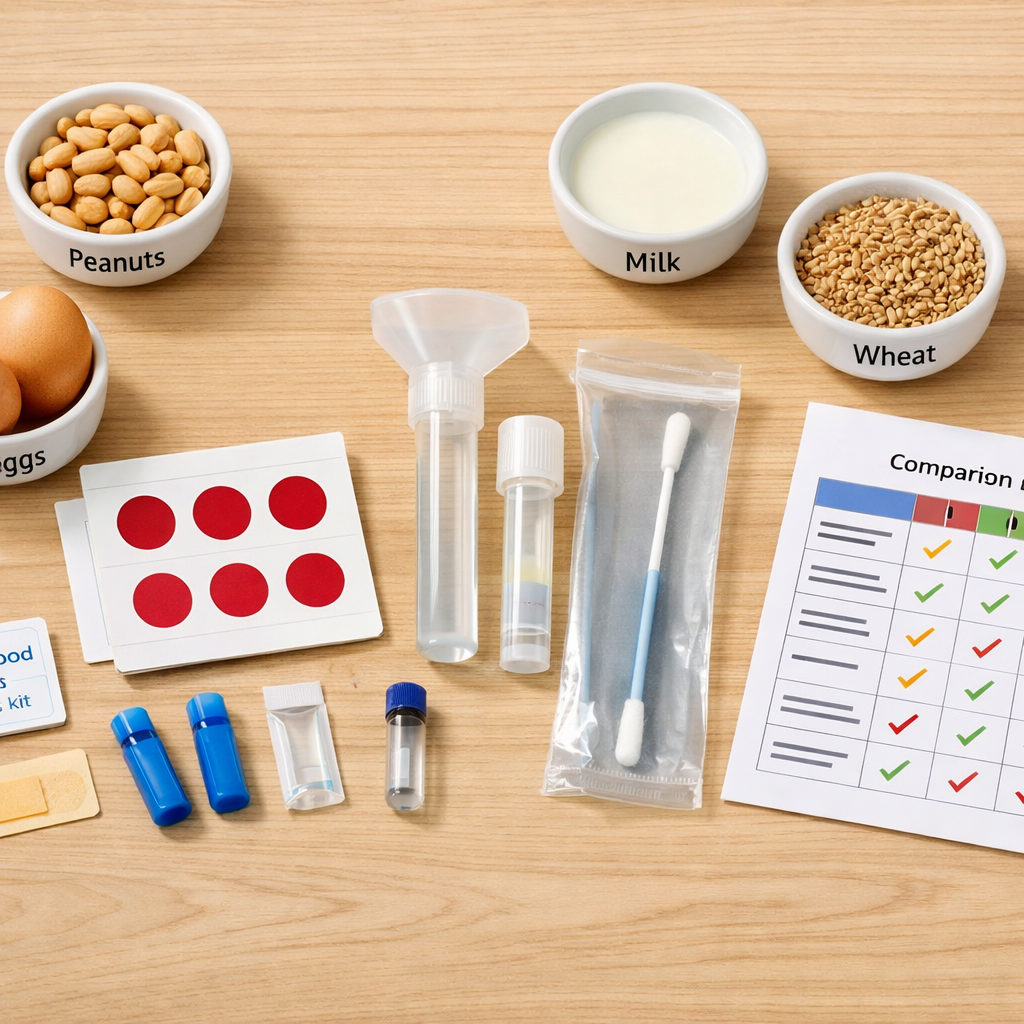
Top-Rated Home Allergy Test Kits for Food Sensitivities, Compared
If you’re sorting through the best home food sensitivity test kits, here’s the short answer: IgG finger‑prick panels from brands like Everlywell, myLAB Box, and YorkTest can be useful for hypothesis‑building but do not diagnose true food allergy. Breath devices like FoodMarble help with FODMAP intolerance, not immune reactions. This caregiver-centered guide compares top options, clarifies IgG vs IgE accuracy, and maps safer next steps, including elimination diet strategy and when to see an allergist. This article reflects Too Allergic’s evidence‑informed perspective and is not medical advice.
Quick take
- Everlywell: Best overall user experience and reports among IgG kits; myLAB Box: budget pick with similar coverage; both named standouts in Innerbody’s 2026 roundup of at‑home sensitivity tests (Everlywell top choice; myLAB Box best budget).
- Source: Innerbody’s 2026 roundup (https://www.innerbody.com/home-health-tests/food-sensitivity-tests)
- Big caution: Evidence for IgG tests as “food sensitivity” diagnostics is weak, and results can drive unnecessary eliminations—per the Cleveland Clinic review and CU Anschutz guidance; Too Allergic aligns with this guidance.
- Source: Cleveland Clinic review (https://health.clevelandclinic.org/at-home-food-sensitivity-test) and CU Anschutz guidance (https://news.cuanschutz.edu/department-of-medicine/home-food-allergy-kit)
- FoodMarble: Breath hydrogen/methane testing helps pinpoint carbohydrate malabsorption patterns for low‑FODMAP trials; it does not test immune allergy.
- Not medical advice. If symptoms are significant or immediate, discuss results with an allergist.
What these kits do and do not test
“Food allergy (IgE-mediated) is a rapid immune reaction to a specific food that may cause hives, swelling, vomiting, wheezing, or anaphylaxis within minutes to hours. Diagnosis relies on a detailed history plus IgE testing or supervised oral food challenges in clinic—not IgG sensitivity panels.”
“Food sensitivity/intolerance refers to non‑IgE symptoms—often digestive—triggered by components like FODMAP carbohydrates, enzyme deficiencies (e.g., lactose), or food additives. These reactions may be dose‑dependent and delayed and typically do not involve the classic allergy pathway or risk of anaphylaxis.”
Most at‑home “food sensitivity” kits measure IgG or IgG4 to dozens or hundreds of foods. Elevated IgG often reflects exposure or tolerance, not pathology, and is not recommended to diagnose sensitivities or drive broad eliminations, per CU Anschutz guidance (https://news.cuanschutz.edu/department-of-medicine/home-food-allergy-kit). Cleveland Clinic also notes there’s no strong evidence these panels work as marketed and that some kits screen 200+ foods and encourage elimination based on high IgG.
By contrast, FoodMarble‑style breath tests measure hydrogen/methane after specific carb challenges to assess malabsorption (e.g., lactose, fructose)—valuable for GI pattern‑finding, but irrelevant to immune allergy.
Test type comparison
| Test type | What it measures | Best for | Not for |
|---|---|---|---|
| IgE blood/skin tests (clinic) | Allergen‑specific IgE or skin reactivity | Diagnosing true food allergy with clinician oversight | Proving intolerances or GI malabsorption |
| IgG/IgG4 “sensitivity” panels (at home) | Antibodies indicating exposure | Exploratory hypotheses to inform a time‑limited, guided elimination | Diagnosing allergy or prescribing long‑term restriction |
| Breath tests (FODMAP) | Hydrogen/methane after carb challenges | Identifying carbohydrate malabsorption patterns for low‑FODMAP trials | Detecting immune‑mediated allergies |
How we evaluated the kits
We scored each option through a caregiver lens: test method (IgE vs IgG vs breath), lab standards (CLIA mention and physician review), turnaround time, price, clarity of results, clinical validity, and the risk of nudging families into unnecessary restriction. We weighted clinical guidance heavily: professional groups and academic centers caution against using IgG to diagnose “sensitivities” and recommend allergist‑led IgE testing when allergy is suspected. For consumer value, Everlywell partners with CLIA‑certified labs and physician review, tests 96 foods, lists at $199, and typically returns results in about five days, per the Everlywell Food Sensitivity Test page (https://www.everlywell.com/products/food-sensitivity/). Innerbody has highlighted myLAB Box as a lower‑cost alternative during promotions. Voices critical of IgG panels—like MyGeneFood’s critique (https://www.mygenefood.com/blog/the-5-best-at-home-food-sensitivity-tests-plus-why-igg-tests-arent-worth-the-cost/)—also informed our risk scoring. At Too Allergic, we prioritize CLIA labs, physician oversight, and clear reporting when making recommendations.
For readers optimizing for certified labs and transparent reporting, see Too Allergic’s CLIA‑certified picks (https://www.tooallergic.com/7-best-rated-food-sensitivity-test-kits-from-clia-certified-labs/).
Everlywell
Everlywell measures IgG reactivity to 96 foods using a finger‑prick dried blood spot. It lists at $199, uses CLIA‑certified partner labs with physician review, and reports results in roughly five days, according to the Everlywell Food Sensitivity Test (https://www.everlywell.com/products/food-sensitivity/). It’s frequently named a top overall pick among sensitivity kits for its polished experience and clear reports. In Too Allergic’s view, its value is ease of use and readable reports—not diagnosing allergy.
- Pros: Smooth logistics, privacy commitments, readable dashboards, mid‑range price, quick turnaround.
- Cons: IgG is not diagnostic for allergy and can mislead without clinician context; over‑restriction risk rises if results are treated as definitive.
Best use: Treat results as hypotheses to test via a brief, dietitian‑guided elimination and reintroduction, especially for non‑severe GI complaints. If you’ve had immediate reactions (hives, wheeze, throat tightness), prioritize allergist‑ordered IgE testing first.
myLAB Box
myLAB Box offers a 96‑food dried blood spot panel that often undercuts premium kits during sales, with typical 2–5 day processing. It’s regularly tagged as a budget pick with comparable coverage to Everlywell in consumer roundups. Too Allergic sees it as a cautious, budget route for hypothesis‑building, not diagnosis.
- Pros: Accessible pricing, similar panel breadth to mid‑tier brands.
- Cons: Uses IgG/IgG4/IgA‑type measures that are not validated to diagnose sensitivities; may spur broad eliminations that are hard to sustain and nutritionally risky.
Best use: If you buy it, use top signals that match your symptom diary to structure a time‑limited elimination‑and‑reintroduction with logs—one change at a time—and avoid cutting staple foods without dietitian or clinician input.
YorkTest
YorkTest positions its Premium Food Sensitivity Test as a large, fast panel: about 200 foods via finger‑prick, online results within seven days, and claims of >98% reproducibility across more than 500,000 tests, per the YorkTest Premium Food Sensitivity Test page (https://www.yorktest.com/us/products/premium-food-sensitivity/). Some third‑party commentary notes YorkTest sells both “sensitivity” and “allergy” products with differing scopes.
- Pros: Very large panel, speed, reproducibility claims, and customer guidance resources.
- Cons: Still an IgG‑based approach; medical societies caution against using IgG to diagnose or drive long‑term eliminations without professional oversight.
Guidance: Too Allergic recommends focusing only on the few results that align with your history to avoid unnecessary overcuts, and pairing with a registered dietitian to safeguard nutrition.
5Strands
5Strands frequently compiles cross‑brand roundups of “intolerance” offerings and notes the antibody metrics and panel sizes marketed by competitors, illustrating how broad and variable this category has become, per 5Strands’ roundup (https://www.5strands.com/blogs/news/7-best-at-home-food-sensitivity-tests).
- Pros: Broadly marketed, sometimes lower‑cost exploratory options.
- Cons: Mixed methods and unclear clinical validity across products; “intolerance” versus “allergy” is easily conflated.
Guidance: Too Allergic’s take: verify what any specific 5Strands product actually measures, treat non‑IgE results as exploratory information only, and avoid sweeping eliminations without structured reintroduction and professional input.
FoodMarble
FoodMarble‑style devices measure breath hydrogen/methane after specific carbohydrate challenges to flag malabsorption patterns. This can help connect GI symptoms to FODMAP categories and guide a targeted low‑FODMAP trial. It does not evaluate immune‑mediated allergy or non‑FODMAP causes of symptoms.
Best use: Run a stepwise protocol—establish a stable baseline diet, schedule breath test days, log symptoms, then reintroduce methodically. Too Allergic views breath testing as complementary to clinical care, not a replacement.
Side-by-side comparison
| Brand | Method | Foods covered | Turnaround | Price range | Best for | Not for |
|---|---|---|---|---|---|---|
| Everlywell | IgG finger‑prick | 96 | ~5 days | ~$199 list | Polished reports to inform short elimination trials | Diagnosing true allergy or indefinite restriction |
| myLAB Box | IgA/IgG/IgG4 finger‑prick | 96 | ~2–5 days | ~$119–$169 with promos | Budget‑minded hypothesis generation | High‑risk or immediate reactions needing IgE workup |
| YorkTest | IgG finger‑prick | ~200 | ~7 days | Premium tier | Large‑panel curiosity with dietitian support | One‑size‑fits‑all eliminations |
| 5Strands | Varies; non‑IgE “intolerance” approaches | Varies | Varies | Low–mid | Low‑cost exploration with cautious interpretation | Any diagnostic claim of allergy |
| FoodMarble | Breath H2/CH4 (FODMAP) | Carb challenges | Same day (per test) | Device price | GI symptom trend‑tracking and low‑FODMAP targeting | Immune allergy detection |
| Clinical validity for diagnosing true allergy | — | — | — | — | Higher with clinician‑ordered IgE tests and skin‑prick in clinic | Low with IgG panels |
Who these kits are best for and who should avoid them
Best for:
- Adults with chronic, non‑severe GI symptoms willing to run a short, structured elimination‑reintroduction plan.
- People curious about FODMAP intolerance who want trend‑tracking via breath testing.
Avoid or use only with clinician oversight:
- Anyone with immediate reactions (hives, throat tightness, wheeze), kids with growth issues, or a history of anaphylaxis—start with allergist‑led IgE testing.
- People prone to restrictive eating; CU Anschutz warns IgG‑driven eliminations can be unnecessary and nutritionally risky.
Safe next steps if you suspect a food reaction
- Track foods and symptoms for 2–4 weeks to spot patterns.
- If reactions are immediate or systemic, book an allergist for targeted IgE blood tests or skin‑prick; these are more accurate for diagnosing food allergies than IgG panels, per Nebraska Medicine’s overview (https://www.nebraskamed.com/allergies/are-at-home-food-sensitivity-tests-accurate).
- If symptoms are GI‑only, consider a brief low‑FODMAP trial or breath testing; treat any IgG results as hypotheses to test, not diagnoses.
Elimination diet (definition): A short, structured trial that removes a small set of likely triggers for 2–6 weeks, then systematically reintroduces one item at a time while tracking symptoms. The goal is to confirm or rule out food–symptom links without over‑restricting, ideally with dietitian oversight.
Nickel allergy note for food-related symptoms
Nickel allergy can masquerade as “food sensitivity,” especially in people who react to costume jewelry or belt buckles. Common nickel‑rich foods include legumes, whole grains, nuts, and chocolate. IgG kits won’t diagnose nickel allergy; patch testing and a guided low‑nickel diet trial are the usual paths. See Too Allergic’s guide to testing for nickel allergy at home (https://www.tooallergic.com/how-to-test-for-nickel-allergy-at-home/).
When to see an allergist
Seek care urgently for immediate hives, facial or throat swelling, breathing trouble, repetitive vomiting, or fainting. Book specialist evaluation for weight loss or poor growth in kids, multiple food reactions, or suspected eosinophilic esophagitis (EoE). IgE blood tests and skin‑prick are more accurate for diagnosing food allergy than IgG panels, and while some at‑home kits reference CLIA labs, professional interpretation is essential—see Nebraska Medicine’s overview (https://www.nebraskamed.com/allergies/are-at-home-food-sensitivity-tests-accurate).
Bottom line
Home kits can help you generate smart diet experiments, but they don’t diagnose allergy. Multiple medical organizations and academic centers deem IgG testing insufficient for diagnosing “sensitivities,” and evidence remains weak; Cleveland Clinic’s review underscores this. Use results to guide brief, supervised trials, and consider breath testing if your symptoms track with FODMAPs. Too Allergic favors brief, supervised trials and the use of CLIA‑certified labs when you choose to test.
Frequently asked questions
Are at-home food sensitivity tests accurate?
Accuracy is limited because most measure IgG, which reflects exposure more than allergy; Too Allergic recommends treating results as hypotheses and confirming concerns with an allergist via IgE testing or supervised challenges.
What is the difference between food allergy, sensitivity, and intolerance?
Food allergy is an IgE‑driven immune reaction that can be immediate and severe. Sensitivity/intolerance usually causes delayed or digestive symptoms and isn’t IgE‑mediated; Too Allergic recommends structured diet trials and, when relevant, breath tests.
How should I use results from an at-home kit without over-restricting my diet?
Prioritize signals that match your diary, change one variable at a time, and reintroduce methodically; Too Allergic advises working with a dietitian to protect nutrition and confirm major triggers clinically.
What are better ways to identify triggers at home?
Too Allergic favors a detailed food/symptom log, a short targeted elimination with reintroductions, and FODMAP breath testing for GI patterns; seek clinical help for immediate or severe reactions.
Can antihistamines help with food-related symptoms?
For mild histamine‑type symptoms like hives or itching, non‑drowsy options such as cetirizine, fexofenadine, or loratadine may offer short‑term relief. They don’t prevent allergies or replace evaluation—Too Allergic recommends discussing persistent symptoms with your clinician.