Top-Rated Affordable Home Allergy Tests: Best Picks Under $150
Allergy care shouldn’t be a luxury. This guide spotlights top-rated, under-$150 at-home tests that can help you screen likely triggers before a clinic visit. From broad environmental panels to focused options, we compare value, accuracy limits, and next steps. At Too Allergic, we’re parent advocates first: use home results as a screening step, not a diagnosis, and seek urgent care for trouble breathing, throat swelling, or anaphylaxis signs. Who this is for: allergy-affected individuals and caregivers looking for affordable (<$150) ways to explore environmental or food-related issues and plan smart follow-up.
What IgE tests are and why they matter: Immunoglobulin E (IgE) testing looks for allergen-specific antibodies that suggest your immune system recognizes a substance. Many at-home kits measure IgE reactivity, which can be useful for environmental allergens like pollen or dust mites; however, reactivity indicates sensitization rather than a confirmed clinical allergy (as noted by Healthline’s overview of at-home testing: https://www.healthline.com/health/allergies/at-home-allergy-test). Too Allergic treats IgE results as a screen to guide follow-up, not a stand-alone diagnosis.
Too Allergic
We’re an independent, parent‑led, research‑informed guide. Our goal is to help you navigate budget-friendly tools safely and realistically—combining practical product comparisons with lived experience across environmental, pet, food, and contact allergies. We prioritize plain‑language guidance, clear caveats, and practical next steps. This isn’t medical advice; if you experience severe symptoms, go to the ER or your doctor first. We treat at-home results as a starting point and recommend confirming meaningful positives with a clinician (expert perspectives consistently emphasize clinical confirmation of home results: https://premiumallergy.com/how-accurate-is-at-home-allergy-testing-expert-insights/).
How we chose these under $150 picks
To make this list, tests needed to be priced at or under $150, clearly describe what they measure, and state turnaround times. At Too Allergic, we favor IgE-based panels for environmental allergens and tests processed by CLIA-certified labs when available; Everlywell, for instance, uses physician-reviewed results from CLIA-certified labs, a benchmark for quality in this space (as profiled by Healthline: https://www.healthline.com/health/allergies/at-home-allergy-test). We flagged or excluded hair-based options and broad “intolerance” claims with limited evidence—there’s no reliable scientific evidence that hair analysis can diagnose food allergies or intolerances, and IgG/IgG4 “sensitivity” tests are not validated for diagnosing allergy (discussed further below).
Comparison at a glance
| Test | Type/markers | Panel scope | Turnaround | Lab standards (CLIA/other) | Price (~) | Pros | Cons | Best for |
|---|---|---|---|---|---|---|---|---|
| Everlywell Indoor and Outdoor Allergy Test | Blood IgE (finger‑prick) | 40 indoor/outdoor allergens | ~5 business days after lab receipt | CLIA‑certified; physician‑reviewed | $149 | Broad environmental panel; clear report | Sensitization ≠ diagnosis; near price cap | Seasonal or indoor symptom sleuthing |
| myLAB Box (select allergy/sensitivity options) | Varies by kit (some IgE; some IgG) | Targeted single analyte or small panels | Typically a few days to ~1 week | Varies by kit/provider | <$150 with promos | Lower upfront cost; narrow questions | Narrow scope; interpretation varies; confirm positives | Budget users with one strong suspect trigger |
| LifeLab Testing | IgE and/or IgG4 (varies by panel) | Up to 40 allergies; up to 80 “intolerances” | ~3–5 days (in some packages) | Not specified/Non‑CLIA | From $135 | Relatively fast; broad menu | IgG4 can mislead; confirm with clinician | Exploratory overview with caution |
| LetsGetChecked Celiac Test | Celiac antibodies (e.g., tTG‑IgA) | Focused celiac screen | ~2–5 days | Accredited lab (details in listing) | ~$119 | Clear pathway if positive | Not a general allergy test; needs medical follow‑up | Suspected gluten‑related disease |
| 5Strands Intolerance Test | Hair sample (nonstandard) | Combined intolerance/environmental | ~1–2 weeks (varies) | Nonstandard; not CLIA | ~$123 | Affordable; user-friendly app | Not diagnostic; risk of unnecessary restriction | Cost‑curious users treating results as exploratory only |
Secondary factors we weighed: clarity of methods, reporting quality, and whether the company provides guidance about next steps.
What at-home allergy tests can and cannot tell you
“ Sensitization means your immune system has produced IgE antibodies to a substance. A positive IgE result suggests recognition—not that you will definitely have symptoms when exposed. Diagnosis generally requires your clinical history plus confirmatory testing, such as skin prick or supervised challenges. ”
“ IgG/IgG4 food testing reflects exposure or tolerance patterns rather than a proven intolerance or allergy. Major allergy societies do not endorse IgG/IgG4 tests for diagnosing food intolerance or food allergy, and results can drive unnecessary dietary restriction (Medical News Today overview: https://www.medicalnewstoday.com/articles/at-home-allergy-test). ”
Most at-home kits use a finger-prick blood spot mailed to a lab, with results in days to weeks and reports that emphasize IgE reactivity and likely sensitizations (Prevention’s buyer’s guide describes common workflows and result types: https://www.prevention.com/health/g40013485/best-at-home-allergy-test/). Be cautious with hair-sample “sensitivity” kits and unvalidated algorithms—they can lead to overly restricted diets without improving symptoms (warnings from academic allergy experts: https://news.cuanschutz.edu/department-of-medicine/home-food-allergy-kit). Always confirm positives and clinically meaningful findings with a healthcare professional. At Too Allergic, we treat non‑IgE “sensitivity” outputs as hypotheses to discuss—not instructions to overhaul your diet.
Everlywell Indoor and Outdoor Allergy Test
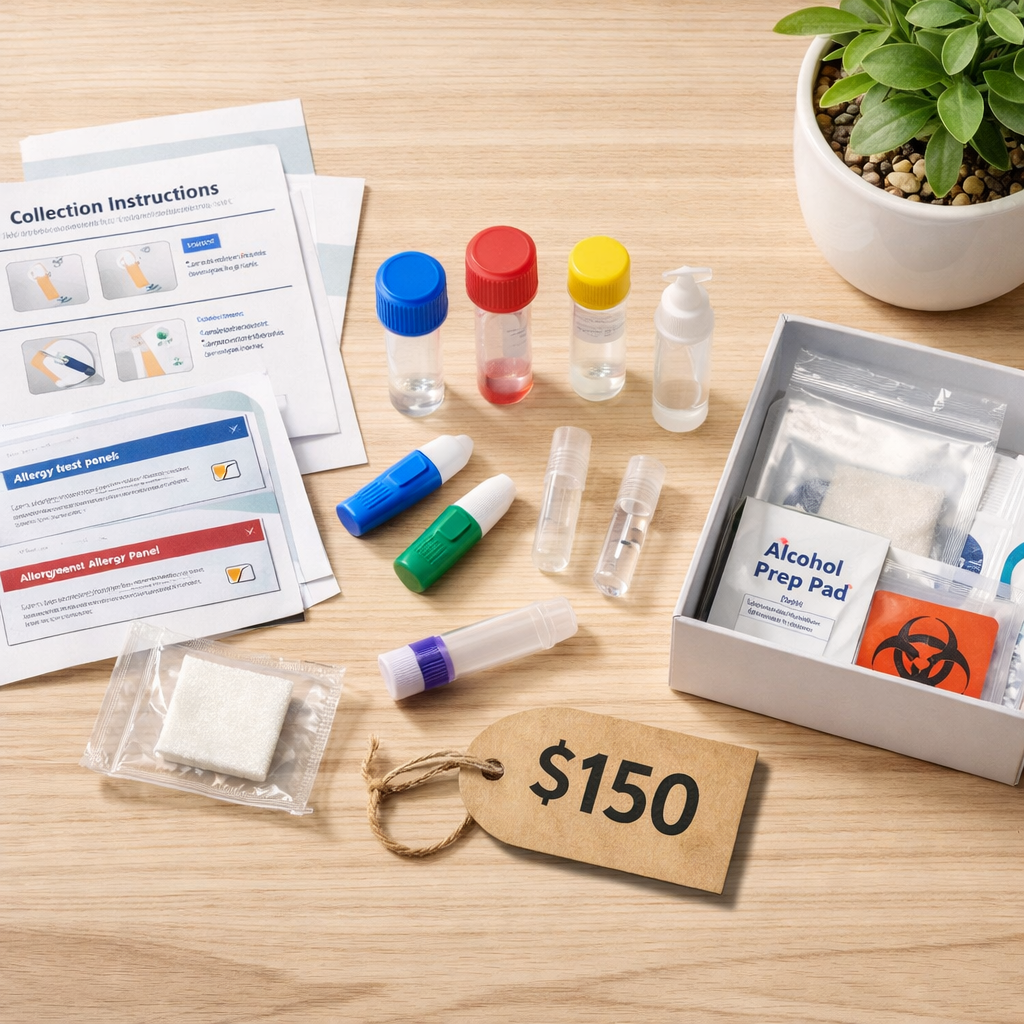
This well-known environmental screen measures IgE reactivity to 40 common indoor and outdoor allergens via a finger-prick sample. Results are generated by CLIA-certified labs and reviewed by a physician, with a typical turnaround around five business days after lab receipt (features highlighted in independent reviews). Use this as a screening step—results indicate sensitization rather than a definitive clinical allergy.
Pros
- Broad 40‑allergen panel with intuitive visuals
- CLIA lab processing; physician-reviewed results
- Clear, actionable report; ~5 business days after lab receipt
Cons
- Not a food allergy diagnosis
- Sensitization ≠ clinical allergy
- Price often near $149
Best for
- Seasonal or indoor symptom sleuthing (dust mites, tree/grass/weed pollen, molds, pet dander)
How to read your report
- Scan the overall summary, then sort allergens by “high” or “very high.”
- Note patterns: indoor vs outdoor; time of year; pet or dust exposures.
- Cross-check your symptom log (nose/eye/skin/asthma) against high-signal allergens.
- Use the report to guide questions for your clinician and to trial targeted avoidance.
myLAB Box
If you have one strong suspect trigger, myLAB Box can be a lower-cost way to ask a narrow question; discounted kits and promos can bring certain single-analyte or small panels under $150, though offerings vary (see Innerbody’s roundup of home sensitivity/allergy options: https://www.innerbody.com/home-health-tests/food-sensitivity-tests).
Pros
- Lower upfront price point with promos
- Targeted, single-allergen or small-panel options
Cons
- Narrow scope; risk of false reassurance or worry
- Methods vary (some kits target IgE, others IgG); confirm positives with a provider
Best for
- Cost-conscious users with a clear hypothesis (one food or one environmental trigger) who plan clinical confirmation
LifeLab Testing
LifeLab offers bundles that can include up to 40 “allergies” and 80 “food intolerances,” with prices starting around $135 and quoted turnarounds of about 3–5 days in some packages. Panels may include IgE and IgG4. Remember: professional societies warn that IgG/IgG4 food testing isn’t validated for diagnosing intolerance or allergy; treat non-IgE findings cautiously and avoid broad eliminations without medical input (see Medical News Today’s evidence review linked above).
Pros
- Relatively fast results and broad menu
- Can surface hypotheses to discuss with a clinician
Cons
- Inclusion of IgG4 can confuse interpretation
- Lab accreditation details vary; confirm any significant results clinically
LetsGetChecked Celiac Test
This focused, under‑$150 screen measures celiac-related antibodies with a typical 2–5 day turnaround (not a general allergy test but helpful when celiac is suspected). A positive result should prompt medical evaluation for diagnosis.
Pros
- Targets a diagnosable condition with clear next steps if positive
- Transparent pricing (~$119) and quick turnaround
Cons
- Narrow scope; not for environmental or general food allergy screening
- Requires medical follow-up for diagnosis and management
What celiac disease is
- Celiac disease is an autoimmune condition where gluten triggers immune damage to the small intestine. Blood tests screen for related antibodies; diagnosis often requires endoscopy/biopsy. Untreated celiac can lead to malabsorption, anemia, and long-term complications.
5Strands Intolerance Test
5Strands markets a combined “intolerance/environmental” screen around $123 using a hair sample. The company notes it does not test for allergies, distinguishing intolerance from immune-mediated allergy (company site: https://www.5strands.com/?srsltid=AfmBOoryufAj0bOJta-qne1Wj3-4p_KYyI3AbZ1HOFFxgjFdawLpfVsi). Independent medical reporting finds no scientific evidence that hair analysis can diagnose food allergies or intolerances, and experts caution these kits can drive unnecessary diet restrictions without benefit.
Pros
- Affordable; user-friendly interface for pattern tracking
- Can prompt helpful conversations about symptoms/exposures
Cons
- Nonstandard markers; not diagnostic for allergy
- Risk of over-restriction; confirm changes with a clinician
How to use results safely and next steps
- Start a simple symptom and exposure log.
- If you’re exploring environmental triggers, prioritize an IgE allergy test and, when possible, CLIA-processed kits.
- Collect and mail your sample promptly.
- Review results alongside your symptom history—not in isolation.
- Confirm meaningful positives with an allergist; discuss skin prick testing or patch testing where appropriate.
- Trial targeted avoidance strategies (e.g., dust-mite covers, pet dander control, masks during high pollen).
- Consider interim relief while awaiting care; our guide to affordable nonsedating antihistamines can help you compare options: https://www.tooallergic.com/8-affordable-nonsedating-allergy-medicines-you-can-buy-today/.
Too Allergic’s bottom line: most reputable at-home kits post results about five business days after the lab receives your sample, while in-office environmental tests can reach roughly 90% accuracy and provide confirmation with skin prick or supervised challenges, per expert reviews. Do not use IgG/IgG4 panels to eliminate broad food groups. Hair-sample tests are not validated for diagnosis. Seek urgent care for breathing difficulty, throat/tongue swelling, wheezing, or symptoms of anaphylaxis.
Frequently asked questions
Are at-home allergy tests accurate enough to guide treatment?
They’re useful first-step screens—especially IgE-based environmental panels—but indicate sensitization, not diagnosis; Too Allergic recommends confirming positives with a clinician before changing treatment.
What is the difference between allergy, sensitivity, and intolerance tests?
Allergy tests target IgE-mediated reactions and often require clinical confirmation. Sensitivity/intolerance tests (often IgG/IgG4 or hair-based) aren’t validated for diagnosing true allergies, and Too Allergic treats non-IgE “sensitivity” results as hypotheses only.
Which sample type is most reliable for environmental allergies?
Blood-based IgE testing is generally the most useful at home for pollen, dust mites, or dander, and Too Allergic favors CLIA-processed options; skin prick testing with a clinician is the safest confirmation step.
When should I see a doctor or go to the ER for allergy symptoms?
Go to the ER for trouble breathing, throat swelling, wheezing, or anaphylaxis signs. Otherwise, Too Allergic advises booking an allergist visit for persistent symptoms or meaningful at-home positives.
How should I choose a test if I’m on a tight budget?
Prioritize IgE-based environmental panels under $150, look for CLIA-certified labs, and consider single-allergen options if you have a strong suspicion; Too Allergic’s picks follow these rules. Avoid diet changes based on broad sensitivity panels without clinician input.