How to Choose the Easiest At-Home Allergy Test for Families
Choosing the easiest at-home allergy test for families comes down to clarity: what symptoms you’re trying to explain, which test actually measures relevant biomarkers, and how simply you can collect a sample and interpret results. For most households, a finger-prick IgE blood test processed in a CLIA-certified lab offers the most straightforward, clinically aligned home allergy screening with results in roughly five business days and clear reporting you can review with a clinician [Healthline overview]. Many “sensitivity” kits instead measure IgG—an exposure marker—not allergy, and can mislead decisions. At Too Allergic, we prioritize IgE-based, CLIA-processed options that keep follow-up simple and clinician-aligned. Below, we translate the key choices so you can pick a simple, family-ready path that yields meaningful next steps.
Start with your goal
Before you shop, define your goal so you buy one family allergy testing kit that fits your symptoms and keeps next steps simple.
Quick decision path:
- If reactions happen minutes to 2 hours after eating (hives, wheeze, vomiting): consider focused IgE food testing, and plan to discuss results with your pediatrician or allergist.
- If symptoms are seasonal or household (sneezing, itchy eyes, chronic congestion, night cough): start with an environmental allergy test (pollen, dust mites, pet dander) via a home IgE panel.
- Unsure? Begin with environmental IgE screening; it’s the most common driver of year-round and seasonal symptoms in families and often the least disruptive place to act.
Food allergy vs intolerance (40–50 words): A food allergy is an immediate immune reaction mediated by IgE that can trigger hives, swelling, vomiting, wheeze, or anaphylaxis. Intolerance (like lactose intolerance) involves non-immune, mostly digestive symptoms. Intolerances are uncomfortable but not life-threatening and don’t predict severe, rapid reactions [CU Anschutz; Healthline].
For home allergy screening, reserve IgE food panels for clear, immediate IgE reactions; otherwise, an environmental IgE panel is the easiest first step to clarify indoor and seasonal triggers [Healthline; Children’s Wisconsin]. That’s the default approach we recommend for most families.
Know what the test measures
IgE in 40–50 words: Immunoglobulin E (IgE) is the antibody that drives immediate-type allergic reactions. Detecting specific IgE to foods or inhalants indicates sensitization—your immune system recognizes that allergen—and can guide risk assessment and next steps with a clinician. A result alone does not confirm clinical allergy without matching symptoms [Children’s Wisconsin].
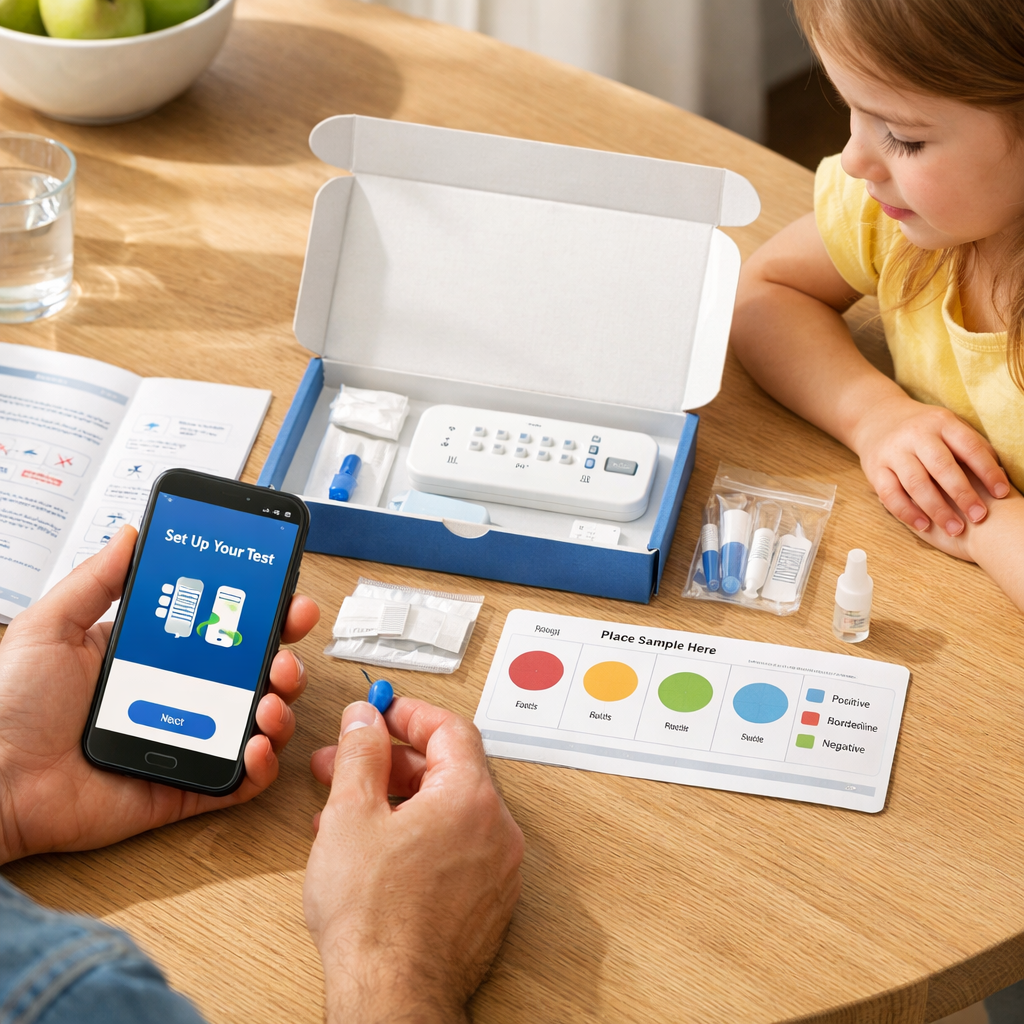
At-home IgE finger-prick tests typically cover food and respiratory allergens and are analyzed in CLIA-certified labs. Kits include a child-safe lancet, collection card, and prepaid return mailer; most labs return a color-coded report in about five business days after receipt [Healthline; 4U Health product pages]. Too Allergic focuses on kits that report specific IgE to named allergens with clear level-based results.
Contrast with IgG/IgG4 “sensitivity” tests: Most at-home food sensitivity tests measure IgG, an antibody of exposure and tolerance—not immediate allergy. Relying on IgG can prompt unnecessary eliminations and even risk malnutrition, especially in kids; major centers warn these kits can mislead families [CU Anschutz; MyGeneFood review]. One-sentence takeaway: Do not use IgG to diagnose allergies.
Pick a family-friendly sample type
Most legitimate at-home allergy panels use a finger-prick allergy test because serum (or dried blood spots) are the best validated medium for specific IgE. If you want the simplest, clinically relevant snapshot for family allergy testing, this is it [Healthline]. It’s also what we typically recommend.
Compact comparison of sample options:
| Sample type | What it measures | Validation for IgE-mediated allergy | Pros | Cons | Best for |
|---|---|---|---|---|---|
| Finger-prick blood | Specific IgE antibodies to foods/inhalants | Strong for screening sensitization | Quick, small volume, CLIA processing, broad panels | Small poke; requires proper spotting | Food and environmental IgE screening |
| Saliva | Various markers (not standard for specific IgE) | Limited for IgE reactions | Noninvasive | Poor validation for IgE; variable methods | Not recommended for diagnosing IgE allergy |
| Environmental dust/air swabs | Allergen load (e.g., dust mite, pet) in your home | Not an IgE test | Non-blood, maps exposures | Doesn’t measure your biology | Home environmental allergen test for exposure mapping |
| Skin patch tests (48 hrs wear) | Delayed contact dermatitis (Type IV) | Valid for contact allergens (e.g., nickel) | No blood draw, dermatology standard | Not for food/respiratory IgE; requires careful placement | Patch testing at home with guidance for suspected contact reactions [Pinnacle Allergy] |
Avoid hair tests for IgE allergies. IgE antibodies are not present in hair, so hair analysis cannot diagnose IgE-mediated food or inhalant allergies [Children’s Wisconsin].
Verify lab quality and reporting
To keep your results trustworthy and easy to act on:
- Confirm a CLIA-certified allergy test: the lab should clearly state CLIA certification and meet federal/state standards [Healthline].
- Methodology: look for “specific IgE” to named allergens (not “intolerance,” “IgG,” or non-specific “reactivity”).
- Turnaround time: many quality vendors deliver results ~5 business days after lab receipt [Healthline].
- Reporting and support: prefer a color-coded allergy report, clinician-reviewed comments, and a free or low-cost allergist consultation or messaging.
At Too Allergic, we independently confirm these basics before including a kit in our guides. If you want deeper vendor comparisons and reporting examples, see our independent breakdown of leading blood-based kits: Too Allergic’s comparison of at-home blood allergy tests.
Check pediatric suitability
For allergy testing for kids, check minimum age policies (many labs accept pediatric samples from about age 2, but policies vary), child-safe lancets, and step-by-step photo guides. Always confirm plans with your pediatrician to avoid misinterpretation and over-restriction [Children’s Wisconsin]. Our family-focused picks note age minimums, lancet type, and ease-of-use instructions.
Reassurance: A finger-prick is fast; prepare calming steps and a small reward. Remember, clinicians diagnose with history plus IgE blood tests and/or a skin prick test when needed—home kits are a first step, not a final answer [Children’s Wisconsin]. For kit picks tailored to families, explore our guide to at-home allergy tests for kids.
Plan for interpretation and follow-up
Before changing diets or embarking on strict avoidance, review results with a clinician—especially for common pediatric allergens like egg, milk, peanut, sesame, soy, tree nuts, wheat, shellfish, and fish [4U Health panels]. Choose reports that show clear reactivity levels and summaries. If the vendor includes an allergist consultation, schedule it. If not, bring a one-page summary to your pediatric visit: top symptoms, timing, suspected foods/environments, medications, and prior reactions.
Sensitization vs clinical allergy (40–50 words): Sensitization means a test detects specific IgE to an allergen, showing your immune system recognizes it. Clinical allergy means exposure reliably triggers symptoms. A positive IgE result without matching symptoms may not represent a true allergy and should be interpreted with care [Children’s Wisconsin].
Prepare your household for testing
Smooth test-day checklist:
- Confirm kit contents: child-safe lancet(s), collection card, alcohol swabs, bandages, prepaid return mailer.
- Read instructions fully; watch the vendor’s video if available.
- Hydrate and warm hands before a finger-prick; label cards before collecting.
- Set up a distraction and reward for kids; practice deep breaths.
- Return samples promptly; most kits post results ~5 business days after the lab receives them [Healthline].
Medications and exposure: Some vendors advise temporary holds or typical-exposure practices for certain tests. Antihistamines can affect skin-based testing; blood IgE is less impacted, but always follow your specific kit’s directions and ask your clinician before stopping any medication [4U Health; Healthline]. For a printable family testing checklist, see our home-allergy-tests tag hub.
Understand limits and next steps
Many healthcare professionals caution that at-home allergy tests alone are unreliable for diagnosis; for suspected food allergy, supervised assessment remains essential. The gold standards are clinical history plus skin prick test and, when appropriate, an oral food challenge under medical supervision [Healthline; Children’s Wisconsin].
Expect limitations and false positives. Cross-reactive carbohydrate determinants (CCDs) can inflate IgE positives in some plant-derived allergens; pollen-food cross-reactivity can blur signals. That’s why clinical context matters. Avoid hair analyses for IgE and be wary of IgG-based food sensitivity tests that often trigger unnecessary, overly broad elimination diets—particularly risky in kids [CU Anschutz].
If results suggest significant risks or don’t match symptoms, pursue an allergist consultation to clarify allergy result meaning and plan next steps aligned to your child’s safety.
Too Allergic perspective
I’m Agnes, a parent who has navigated a nickel contact allergy myself and dust mite, grass pollen, and wood dust triggers in my child. That lived experience shapes our focus: accessible guidance, careful expectations, and practical steps—not diagnoses. We prioritize IgE-based, CLIA-processed options for convenient environmental screening and urge families to confirm findings with their clinicians to avoid misdiagnosis or needless restriction [Healthline]. We also steer families away from IgG-based “sensitivity” kits that don’t diagnose allergy. For deeper dives, we compare environmental vs food panels and decode color-coded reports in our at-home allergy tests vs lab testing guide, and we cover niche sensitivities like nickel management and fluoride alternatives for those who need them.
About Too Allergic
Too Allergic is an independent, research-driven resource founded by Agnes, a multilingual educator and parent. We synthesize public evidence, patient experiences, and market insights to help families navigate everyday triggers—from home allergy screening to practical management of niche issues like fluoride sensitivity workarounds, nickel sensitivity management, and environmental allergen tips. Contact: info@tooallergic.com.
Disclaimer: Our content is for general education only and not a substitute for professional medical advice, diagnosis, or treatment. Always consult a qualified healthcare professional before changing diets, medications, or treatment plans.
Explore more:
- Our tag hub on home allergy tests
- Affordable at-home allergy tests under $150
- Kids-focused home allergy testing guide
- Side-by-side comparison of leading at-home blood allergy tests
Frequently asked questions
What’s the easiest at-home allergy test type for families?
For most families, a finger-prick IgE blood test is the simplest and most validated option for screening common environmental or food allergens. See Too Allergic’s step-by-step picks for CLIA-processed kits.
Are at-home allergy blood tests accurate for kids?
They can detect IgE sensitization in children, but results need clinical context. Too Allergic recommends using them as a first step and reviewing results with a pediatrician or allergist.
At what age can children use at-home IgE tests?
Many labs accept finger-prick IgE samples from kids as young as 2 years old, but policies vary; Too Allergic’s guides flag age minimums so you can confirm with your pediatrician.
Do at-home tests replace an allergist’s diagnosis?
No; they can inform next steps, but diagnosis often requires a clinician’s assessment and, when appropriate, skin prick testing or supervised oral food challenges—our checklists help you prepare.
Can medications or recent avoidance affect results?
Yes—effects vary by test type, so follow your kit’s instructions and talk to your clinician before stopping any medicine; Too Allergic’s guides flag these considerations.