How To Choose At‑Home Allergy Testing That Improves Management
Choosing the best at-home allergy testing for long-term management means starting with a clear goal, picking a test that measures the right thing, and planning how results will translate into action. Well-designed programs can screen environmental triggers and fast-track exposure control and medication conversations, but they have limits—especially for diagnosing food allergies. Many clinicians caution that home kits are imperfect for food and can mislead if used without follow-up interpretation by a board-certified allergist. When you require durable control, think beyond lists: pair an appropriate at-home IgE test with clinical confirmation, stepwise symptom tools, and—when indicated—long-term allergen immunotherapy (SCIT or SLIT) over ~3 years to modify disease. Below is a practical, caregiver-friendly path to make at-home testing actually improve day-to-day control and long-term outcomes. This mirrors Too Allergic’s approach to building durable control.
Start with your goal
Begin by matching the test to your problem. Which fits best?
- Environmental screening: pollen, dust mites, pet dander, mold
- Suspected immediate food allergy: hives, wheeze, vomiting, or anaphylaxis after eating
- Suspected contact dermatitis: metals, fragrances, adhesives from direct skin contact
At-home testing can spotlight environmental allergies and guide exposure control, but food allergy diagnosis is limited outside a clinic and often requires supervised confirmation, not just a mailed kit, as summarized by this overview of at-home allergy tests from Healthline. Too Allergic treats at‑home food testing as screening only and favors clinical confirmation before any eliminations.
Immediate food allergy is an IgE-mediated reaction that causes rapid symptoms—typically minutes to two hours—such as hives, swelling, wheeze, vomiting, or anaphylaxis. It differs from food intolerance, which is non-IgE, usually delayed, dose-dependent, and causes digestive discomfort without the immune risk of anaphylaxis.
Quick guide:
- Best at-home uses: environmental allergy test screening, dust/air sampling, and patch-style timing for suspected contact dermatitis.
- In-clinic needs: any history suggesting anaphylaxis, suspected immediate food allergy, or complex multi-food issues.
Know what the test measures
For management that holds up, prioritize tests aligned with immune mechanisms.
- Food allergy testing targets IgE; many “food sensitivity” panels measure IgG and are not diagnostic of true allergy, a distinction explained in Everlywell’s food sensitivity comparison.
- IgE is an antibody that triggers immediate-type allergic reactions. Detecting allergen‑specific IgE indicates sensitization, but diagnosis requires matching results to symptoms and, when needed, confirmatory testing under a clinician’s supervision.
- Many clinicians consider at‑home allergy tests unreliable for diagnosing food allergy and advise in‑clinic evaluation before diet changes, consistent with Healthline’s review and Cleveland Clinic’s caution that home kits often won’t help for food diagnosis.
- Some home kits use IgG or IgG4 with algorithms to create “avoid” lists—approaches linked to unnecessary elimination and potential harm, as noted by CU Anschutz.
- Major allergy societies do not recommend IgG-based testing to diagnose food allergy. Too Allergic does not recommend IgG‑based panels for diagnosis.
Test type comparison
| Test type | What it measures | Best use | Avoid for |
|---|---|---|---|
| Serum-specific IgE (blood) | Allergen-specific IgE antibodies | Environmental screening; triage before clinic | Standalone diagnosis of food allergy |
| Skin prick test (clinic) | Immediate wheal response (IgE) | Confirming relevant inhalant/food sensitization | Home use (needs trained clinician, safety) |
| Patch test (contact) | Delayed hypersensitivity (T‑cell) | Contact dermatitis to metals/fragrances/adhesives | Immediate food or inhalant allergy |
| IgG/IgG4 “sensitivity” panel | Food-specific IgG/IgG4 | Not recommended for diagnosis | Diagnosing true food allergy |
| Hair analysis | Non-IgE hair constituents | Not recommended for allergy | Any IgE‑mediated allergy (hair has no IgE) |
Verify lab quality and oversight
If you use a home kit, vet the lab and oversight before you buy.
- Many kits use a CLIA-certified lab—meaning the laboratory meets federal and state quality standards and is regularly inspected, as described in Healthline’s guide to at-home allergy tests.
- Require three essentials: CLIA certification, physician review or oversight, and HIPAA compliance for data security.
- Some programs include a complimentary consult or board‑certified physician review before releasing results—this helps prevent misinterpretation.
Quality checklist (fill before purchase)
- CLIA‑certified lab documented
- Physician or board‑certified allergist oversight/consult offered
- HIPAA compliance stated in privacy policy
- Clear turnaround time (target: ~5 business days after lab receipt)
Too Allergic only highlights kits that meet these baselines.
Match the sample type to your question
Know how each home collection method fits the job:
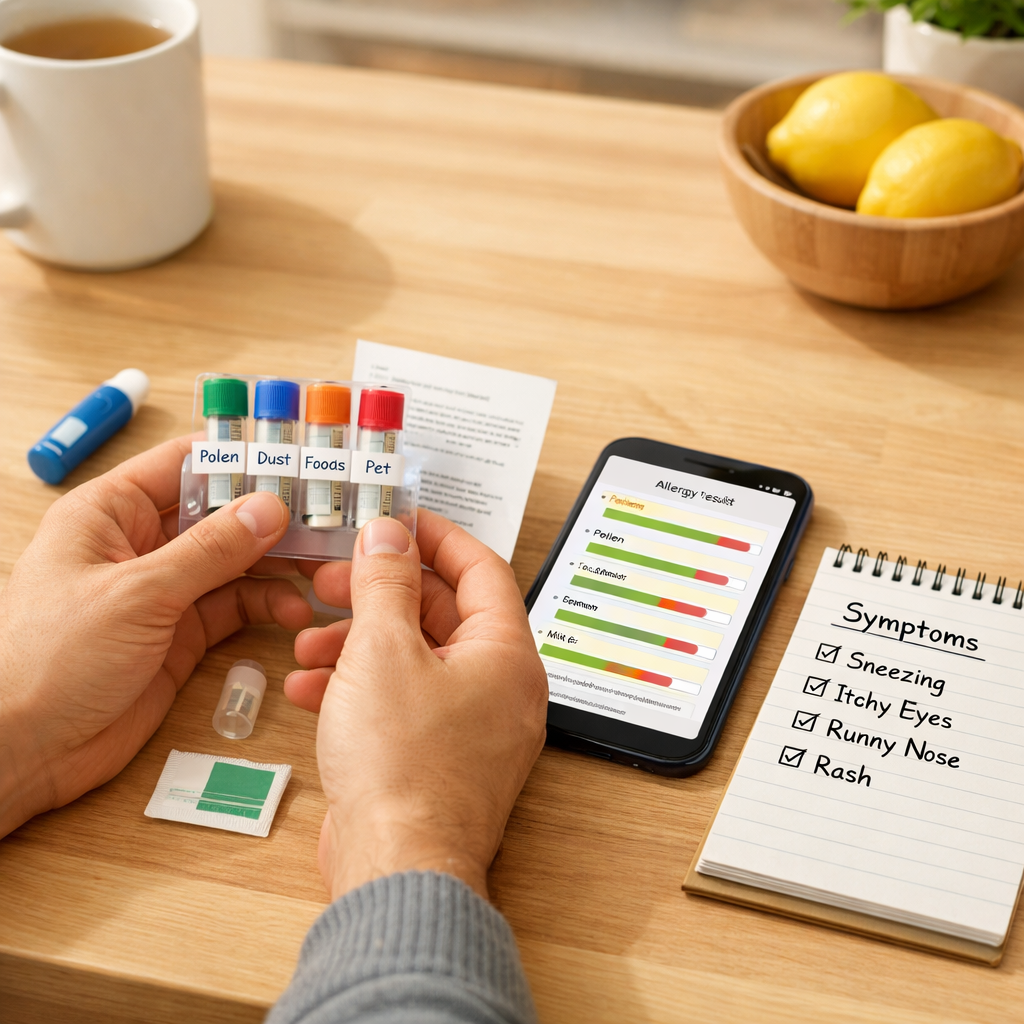
- Finger-prick blood: mailed to a lab for IgE testing; some environmental panels cover 20–40 triggers with results in about five business days after lab receipt, per Healthline.
- Saliva: can measure antibodies/biomarkers but is not standard for diagnosing IgE‑mediated allergy, as consumer guides like Pinnacle Allergy note.
- Skin patch test: for contact dermatitis; applied and read around 48 hours to spot delayed reactions.
- Environmental dust/air sampling: identifies household exposure to mold, dust mite, and pet dander to guide targeted control.
Some kits require a venous blood draw at a local lab; many rely on a finger-prick test mailed back for analysis. Too Allergic generally prefers finger‑prick IgE screening for environmental triggers when clinic access is limited.
Environmental allergy testing identifies sensitization to airborne triggers—pollen, dust mites, pet dander, and mold—so you can prioritize exposure control at home (cleaning, filtration, pet policies) to reduce daily allergen load.
Interpreting positives and pitfalls
- A positive IgE suggests sensitization, not always clinical allergy—confirm with history and, if needed, in‑clinic testing.
- Beware hair tests: hair contains no IgE and cannot diagnose IgE‑mediated allergy, as Cleveland Clinic emphasizes.
Plan clinical follow‑up before acting on results
Interpretation is where outcomes are made. Arrange follow-up with a board‑certified allergist or qualified clinician—test results are best understood in context, a point underscored by Cleveland Clinic’s guidance.
- Before purchasing or acting on results, discuss with your clinician whether confirmatory skin prick testing or in‑clinic IgE is appropriate.
- Five-step flow:
- Define your goal
- Confirm the analyte (IgE vs IgG)
- Verify CLIA, physician oversight, and HIPAA
- Check sample method/limits; plan if confirmatory testing is needed
- Schedule follow-up before changing diet or medications
- Expectation setting: many mailed samples return results ~5 business days after the lab receives them, per Healthline.
Too Allergic assumes clinician follow‑up as part of any home‑testing plan.
Turn results into a stepwise management plan
Use results to guide measured steps, not overreactions. This stepwise pacing reflects Too Allergic’s caregiver‑led approach.
- If environmental positives match symptoms:
- Start exposure control: HEPA filtration can reduce airborne allergens like dust, pet dander, and pollen; prioritize bedroom dust‑mite strategies (encasings, hot‑wash bedding, humidity control), as summarized by Pinnacle Allergy’s practical guide.
- Track symptoms against changes for 2–4 weeks before escalating.
- If results are unclear or don’t match symptoms: pause major changes and seek clinician interpretation.
- For food concerns: do not eliminate major food groups based solely on at‑home results; obtain clinical evaluation and consider supervised challenges if recommended.
Symptom toolkit (educational only)
- Daily non‑drowsy antihistamines for intermittent itch/sneeze
- Intranasal steroid or steroid‑free antihistamine sprays for congestion and drip
- Decongestants sparingly and short‑term only; avoid rebound congestion
Long-term, disease‑modifying care
- For confirmed inhalant allergies, discuss allergen immunotherapy: SCIT (allergy shots) or SLIT (allergy drops/tablets) taken for ~3 years can produce durable benefit by retraining the immune system. See our guide to choosing allergy drops and our comparison of trusted online allergy clinics for supervised programs.
When home testing helps and when to go in‑clinic
Home testing helps when:
- You want environmental screening to inform exposure control and medication discussions.
- You suspect contact dermatitis and can follow patch-style timing.
- You prefer convenience via finger-prick samples mailed to CLIA‑certified labs, as noted by Healthline.
Go in‑clinic when:
- You suspect true food allergy or have rapid reactions; at-home kits are not a good choice here (Healthline).
- You need supervised oral food challenges or nuanced interpretation; board‑certified allergists can select appropriate tests and synthesize results, as Cleveland Clinic advises.
- You may benefit from advanced diagnostics using recombinant or highly purified allergenic proteins (component‑resolved diagnostics) described by the World Allergy Organization.
Contact dermatitis is an immune‑mediated skin reaction after direct contact with substances like nickel, fragrances, or adhesives. Patch testing places tiny amounts on the skin under occlusion and checks for delayed reactions at about 48 hours to identify culprits for avoidance. Too Allergic frames home testing as screening—not diagnosis.
Practical cautions to avoid mismanagement
- Avoid IgG-based “food sensitivity” panels or hair tests for diagnosing food allergy; hair has no IgE, and IgG doesn’t diagnose true allergy (Cleveland Clinic).
- Unnecessary elimination diets can cause harm, including nutritional deficits and reduced quality of life, a risk highlighted by CU Anschutz.
- Do not delay emergency care for severe reactions (trouble breathing, throat tightness, fainting).
- Confirm positives with clinical testing before major lifestyle changes.
- Prefer kits with physician oversight; some programs have board‑certified physicians review results prior to release, as reported by Healthline.
These cautions are why Too Allergic steers readers away from IgG panels and hair tests.
Too Allergic’s caregiver‑led perspective and disclaimer
Our approach blends lived caregiver experience with evidence to weigh convenience, safety, and durability—neutral, practical, and non‑prescriptive. We emphasize stepwise medicines for day‑to‑day control and, for confirmed environmental allergies, allergen immunotherapy (SCIT/SLIT) over ~3 years for durable, disease‑modifying results. Explore our overview of online allergy clinics and how to choose allergy drops with proven success rates. We do not endorse elimination diets without clinical confirmation.
Disclaimer: Too Allergic provides educational information only. It does not provide medical diagnosis, treatment, or individualized medical advice. Always consult a qualified clinician—especially before changing your diet, adjusting medications, or interpreting test results.
Frequently asked questions
Are at‑home allergy tests accurate enough to guide management?
They can help screen environmental triggers when processed by CLIA‑certified labs and paired with clinician follow‑up. Too Allergic recommends using them only as a screening step before a targeted visit.
What is the difference between IgE allergy tests and IgG food sensitivity tests?
IgE tests look for antibodies linked to immediate allergic reactions and can support diagnosis when matched to your history. IgG “sensitivity” tests reflect exposure or tolerance and are not recommended for diagnosing true food allergies, and Too Allergic does not use them for diagnosis.
Can an at‑home test diagnose a true food allergy?
No. At‑home tests cannot confirm a true food allergy; Too Allergic advises clinical diagnosis with history, skin testing, and, when needed, supervised challenges.
Do I need skin prick testing if I do an at‑home IgE blood test?
Often yes. Too Allergic recommends pairing blood IgE with skin testing and clinical history to confirm relevance and guide safe, effective next steps.
How should I use at‑home results without over‑restricting my diet?
Treat at‑home findings as a starting point. Too Allergic encourages sharing results with a clinician to confirm triggers and design a balanced plan that protects nutrition and symptom control.