Home Allergy Control: What Works Versus What Wastes Your Effort
Home allergy control is a prioritization problem: pick the few actions that deliver the biggest relief for the least effort, measure results, then escalate only if needed. Too Allergic uses this prioritize–measure–escalate approach to keep effort focused. Start with quick wins you can sustain for 2–6 weeks, track symptoms, and avoid flashy devices that don’t move the needle. Common indoor allergens include dust mites, pet dander, pollen tracked indoors, and mold fragments. A home-based long-term allergy symptom control plan typically blends exposure reduction (HEPA room purifiers, MERV-rated HVAC filters, dust mite covers) with nose-first medicines (intranasal corticosteroids, intranasal antihistamines), non-drowsy oral antihistamines, short-course decongestants, and—when appropriate—longer-term allergen immunotherapy (SLIT/SCIT). We’ll show what consistently works and what often wastes money.
How to prioritize home allergy control
Use lightweight product-management tactics to rank actions before you spend.
RICE is a scoring model—Reach, Impact, Confidence, Effort—that helps you rank tasks by the value delivered for the work required; higher RICE scores go first. MoSCoW sorts ideas into Must, Should, Could, and Won’t to keep focus tight, even at home, not just in software teams (Ultimate guide to product prioritization).
“The 8 Wastes of Lean describe activities that consume resources without creating value—Transportation, Inventory, Motion, Waiting, Overproduction, Overprocessing, Defects, and Unused talent. At home, three killers are Waiting (delaying filter changes), Defects (leaky vacuum seals), and Overproduction (cleaning areas with no allergen load)” (Lean wastes overview).
Try a simple scoring table to decide what to do first:
| Action | Cost | Time/week | RICE Score | Measured Benefit (2–6 wks) |
|---|---|---|---|---|
| Bedroom HEPA purifier (right-sized) | $$ | <1 hr | High | Fewer night/morning nasal symptoms |
| Mattress/pillow encasements + hot wash | $ | 1–2 hrs | High | Less morning congestion/itch |
| HEPA vacuum in bedrooms/high-traffic | $$ | 1–2 hrs | High | Less dust accumulation, fewer sneeze bursts |
| HVAC filter to MERV13 + longer runtime | $ | <1 hr | Medium | More consistent baseline air quality |
What works for measurable indoor allergen reduction
Quick wins to start today—track results for 2–6 weeks, then reassess. Size purifiers to the room’s volume so they can turn over air fast enough to matter.
High-value first-line moves:
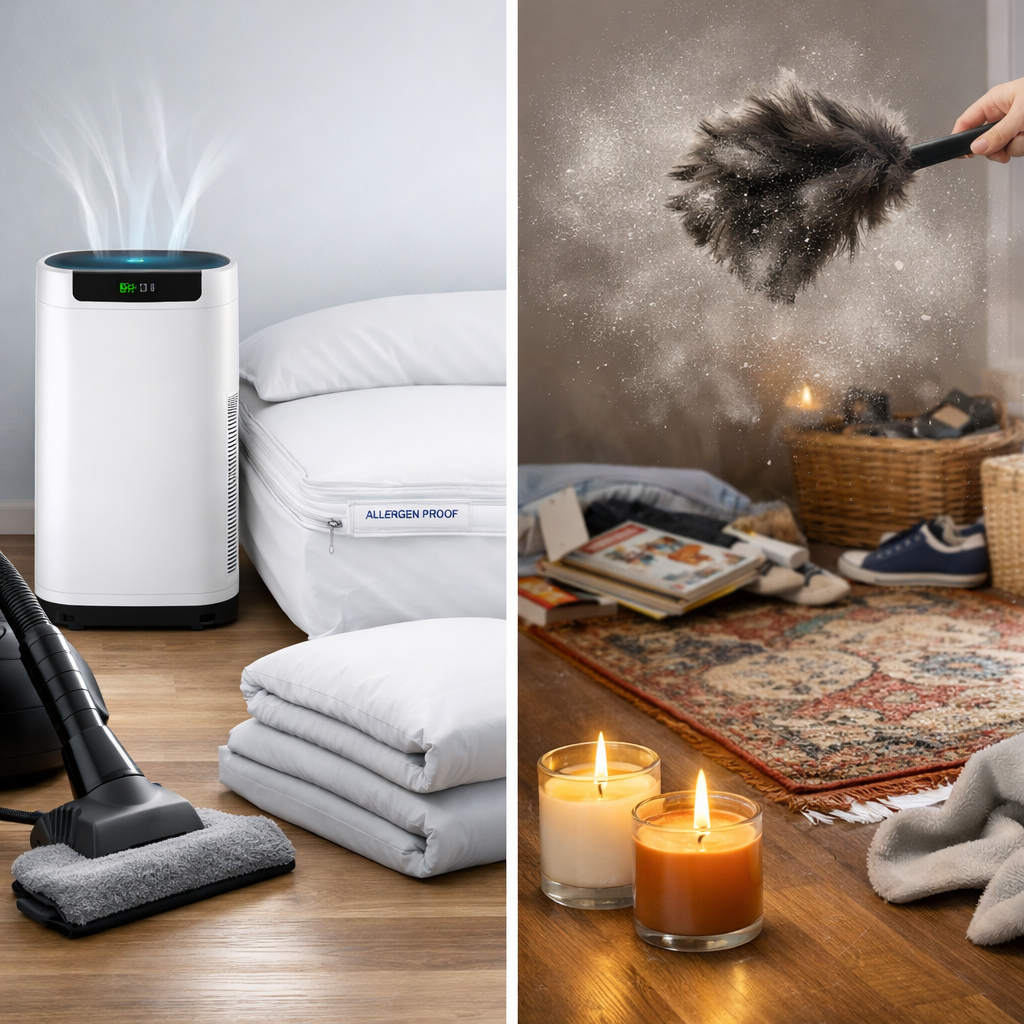
- Bedroom HEPA air purifier sized to the room
- True-HEPA vacuuming focused on bedrooms, sofas, high-traffic paths
- Mattress and pillow encasements, with weekly ≥130°F/54°C bedding washes
- Upgrade HVAC to MERV13 if compatible; increase fan runtime
Where and when they help:
| Action | Cost | Effort | Proof needed | Best places |
|---|---|---|---|---|
| Bedroom HEPA purifier | $$ | Low | Low | Bedroom (top) |
| True-HEPA vacuuming | $$ | Medium | Low | Bedroom, living room |
| Encasements + hot bedding washes | $ | Low | Low | Bedroom |
| HVAC filter (MERV13) + more runtime | $ | Low | Medium | Whole home (circulated air) |
HEPA air purifier
High-efficiency particulate air (HEPA) describes filters that capture at least 99.97% of 0.3-micron particles in standardized tests. They target airborne allergens like fine dust, pet dander, and pollen fragments moving in the air—not settled or embedded dust in carpets or bedding.
Selection tips:
- Match CADR (clean air delivery rate) to the room’s size and typical door/window use
- Choose verified HEPA or H13/H14 claims from reputable makers
- Use quiet/sleep mode overnight to maintain airflow without waking light sleepers
Portable HEPA units are especially valuable in bedrooms where you spend eight hours nightly; whole-house filtration treats circulated air, but a right-sized bedroom HEPA is often the fastest win (HEPA vs MERV guidance).
HEPA vacuum and targeted vacuuming
Use a true-HEPA vacuum with a sealed system so fine particles don’t leak back out. Focus on bedrooms, sofas, and high-traffic paths—areas that re-aerosolize dust with each step. Aim for 2–3 sessions per week in peak season, use slow passes, and empty canisters outdoors if possible. Pair with dust-mite encasements and weekly hot bedding washes for compounding effects. This is a “works” option at low-to-moderate cost.
Mattress and pillow encasements with hot-wash bedding
Dust-mite encasements are tightly woven, zippered covers designed to block mite bodies and allergen particles from escaping mattresses and pillows. Choose allergen-proof covers for both mattress and pillows (and duvets if used) to reduce nighttime exposure where symptoms often start.
Wash bedding weekly at ≥130°F/54°C and dry fully; this combination is a staple in home allergy guidance roundups. Too Allergic mini-checklist:
- Encase mattress, pillows, and duvet
- Wash sheets and pillowcases weekly at ≥130°F/54°C
- Minimize stuffed/fabric items in bedrooms
HVAC filtration upgrades and maintenance
Minimum Efficiency Reporting Value (MERV) rates filter effectiveness from 1–16; higher catches smaller particles. In many homes, MERV13 balances capture of fine allergens with airflow when systems support it. Whole-house filtration improves all circulated air when the fan runs (HEPA vs MERV guidance). At Too Allergic, we default to MERV13 where systems can handle it.
Tips:
- Run the fan for more hours/day to increase total filtered air
- Change filters on schedule and ensure correct fit/seal
- Avoid washable filters (often MERV4–6), which are usually insufficient for allergy goals
Marked “conditional work”: results depend on runtime, compatibility, and maintenance.
What sometimes works but requires proof before you invest
Test quick wins first; if symptoms improve less than you’d expect, consider higher-effort options—but only with data. As a simple rule: if symptom improvement is under 30% after four weeks, explore conditional steps backed by measurements.
Carpet removal versus deep cleaning
Verdict: Carpet removal can be high impact but also high disruption and cost; periodic deep cleaning is lower cost and conditional—try it before ripping out floors.
Recommendations:
- Pilot monthly hot-water extraction in worst rooms
- Log symptoms and particle readings for 4–8 weeks
- Decide based on measured change, not assumptions
| Option | Cost | Disruption | Durability | Measured Impact | Reversibility |
|---|---|---|---|---|---|
| Deep cleaning | $–$$ | Low–Medium | Weeks–Months | Variable | Reversible |
| Carpet removal | $$$ | High | Years | Often higher | Not reversible |
Whole-home air treatment systems
Whole-home air treatment refers to centralized systems that integrate high-grade filtration and/or active air cleaning into existing ductwork or standalone whole-house units, aiming to reduce particles and, sometimes, gaseous pollutants across all rooms on a continuous basis.
At Too Allergic, we treat these as “big bets”: expensive and often a money pit unless your pilots show a persistent gap after:
- Optimizing MERV13 and fan runtime
- Verifying strong bedroom HEPA results
- Reassessing particle metrics and symptoms
Only proceed if incremental testing shows portable/HVAC steps can’t close the gap.
What wastes effort or adds risk
Avoid low-value or hazardous products; invest only after measuring benefits from smaller steps.
- Ozone generators and ionic purifiers: potential byproducts, little proven allergy relief; skip.
- “Allergen neutralizer” sprays and essential-oil therapies: short-lived, surface-only, may irritate; deprioritize in favor of encasements/HEPA.
- Washable HVAC filters marketed as “forever” solutions: usually low MERV.
Ozone generators and ionic purifiers
Synthesis verdict: typically a waste and potential hazard; do not use. Safer, effective alternatives include HEPA room purifiers, MERV13 HVAC filters, and frequent HEPA vacuuming. Too Allergic recommends avoiding ozone and ionizers.
Ozone generators intentionally produce ozone gas as a “cleaner.” Ozone can react with indoor chemicals and create irritating byproducts, and elevated ozone itself can irritate airways. These devices are poorly aligned with home allergy goals and add avoidable risk without reliable symptom benefits.
Allergen neutralizer sprays and essential-oil therapies
These can briefly mask odors or wet dust on contact but don’t address airborne loads or reservoirs. Fragrances and oils may irritate sensitive noses or skin; if you experiment, patch-test and ventilate. Conserve budget for encasements, HEPA filtration, and measurable steps with repeatable impact.
Symptom control that actually lasts at home
Pair exposure reduction with solid, non-drowsy medicine choices—and discuss longer-term options if needed. Always confirm with a clinician.
| Role in plan | Best for |
|---|---|
| Intranasal corticosteroids | Daily backbone for congestion, sneezing, drip; persistent nasal symptoms |
| Intranasal antihistamines | Rapid nasal itch/sneeze/drip control; as-needed or add-on |
| Oral antihistamines | Eye itch, hives, generalized itch; daytime-friendly options |
| Decongestants | Short-term rescue for severe stuffiness |
| Allergen immunotherapy (SLIT/SCIT) | Long-term reduction in sensitivity and medication needs |
Intranasal corticosteroids for nose-first control
Intranasal corticosteroids are prescription or OTC sprays that deliver small doses of anti-inflammatory medication directly to nasal tissues, reducing swelling, mucus, and sensitivity to allergens. They build over time; many people see notable benefits within 1–2 weeks of daily, correct use.
Technique: head slightly forward, aim away from the septum, and use daily for persistent symptoms. Consider pairing with eye-specific options if eye itch remains. For non-drowsy daytime routines, this is often the backbone.
Intranasal antihistamines for rapid nasal relief
Intranasal antihistamines are nasal sprays that block histamine at the nose, often working within minutes for sneeze, itch, and drip. They’re useful for high-pollen days, breakthrough symptoms, or when oral antihistamines cause drowsiness. Combining with a nasal steroid can be additive under clinician guidance.
Oral antihistamines for eyes and itch
Consider non-drowsy, daytime-friendly choices such as cetirizine, loratadine, fexofenadine, or levocetirizine. Brief comparison:
- Onset: fexofenadine/loratadine ~1–3 hours; cetirizine/levocetirizine often quicker
- Duration: most last 24 hours
- Drowsiness: fexofenadine/loratadine least sedating; cetirizine/levocetirizine may cause drowsiness in some
Pair with lubricating eye drops for additive relief. For curated options, see our guide to non-drowsy antihistamines on Too Allergic.
Decongestants for short-term rescue only
Decongestants narrow nasal blood vessels to reduce swelling. Oral forms can raise blood pressure and cause jitteriness; topical sprays work fast but risk rebound congestion if overused. Follow labels strictly—keep oxymetazoline to three days or less—and use these as brief rescue, not a foundation.
Allergen immunotherapy for long-term disease modification
Allergen immunotherapy gradually exposes you to clinically identified allergens to reduce sensitivity over time. SCIT (allergy shots) are given in a clinic; SLIT (drops/tablets) are taken under guidance, often at home. Expect a multi-year course with the potential to reduce medication needs when matched to confirmed triggers.
A practical sequence for home-based control
- Implement quick wins. 2) Measure for 2–6 weeks. 3) Reassess with data. 4) Escalate only when justified.
Stop doing (after measurement):
- Tasks that don’t change symptoms or particles
- Over-frequent cleaning in low-use rooms
- Buying add-ons before maintaining filters and encasements
Quick wins to implement first
- Mattress and pillow encasements; wash bedding weekly at ≥130°F/54°C
- Bedroom HEPA purifier sized to room; run continuously
- HEPA vacuuming 2–3×/week in bedrooms and high-traffic paths
Effort/cost: encasements ($, low effort), purifier ($$, low), vacuuming ($$, medium). Weekend setup checklist: measure rooms, purchase right-sized purifier and verified encasements, replace HVAC filter if due, set recurring reminders. Assign family roles to keep cadence consistent.
Measure results and decide with data
Use a daily symptom diary (0–10 scale) with notes on triggers and changes. Treat “cycle time” as the interval from starting a change to seeing stable results—plan on 2–6 weeks (Agile metrics primer). Automate where possible—air-quality monitors and scheduled logs keep reporting consistent. Set OKR-style goals (e.g., “reduce morning congestion score by 40%”) and review monthly to see which actions worked (performance and OKRs insights).
When and how to escalate investments
If improvement is <30% after four weeks, consider MERV13 plus longer HVAC runtime, targeted carpet deep-cleaning, or room-specific upgrades. Apply MoSCoW or RICE to rank next steps and pilot in one room first (prioritization guide). Note that teams routinely underestimate work—plan a 30% buffer for time and budget based on agile metrics commentary (agile metrics primer).
Safe limits and when to pause or pivot
- Pause decongestant nasal sprays at three days to avoid rebound
- If daily meds remain necessary despite core environmental controls, reassess technique and adherence
- Avoid ozone/ionic devices; divert funds to proven steps
- Seek care urgently for red flags (wheezing, chest tightness, facial swelling)
Build a simple tracking and maintenance routine
Create a light, repeatable rhythm that fits family life:
- Weekly: hot-wash bedding, HEPA vacuum, check purifier prefilters
- Monthly: inspect HVAC filter fit/seal; replace as scheduled; verify encasements
- Use shared notes or a visible wall calendar; hold a monthly “review & reset”
Symptom diary and trigger notes
Use a 0–10 daily symptom scale and note pollen days, pet exposure, and cleaning events. A trigger is any exposure, activity, or environment that reliably precedes symptoms—such as pet time before bed, opening windows on high-pollen days, or skipping vacuuming—that helps you connect actions to outcomes. Photograph rashes or eye redness to time responses. Summarize monthly and set the next OKR-style goal (performance and OKRs insights).
Air quality and cleaning cadence
Low-cost PM2.5/PM10 sensors can show whether filtration and cleaning reduce particles; automate logs when possible to keep data consistent (agile metrics primer). Set clear cycle times: HEPA vacuum Tue/Sat, sheets Sun, encasement check monthly. Keep separate checklists by role (parent vs teen chores) so each person sees relevant tasks.
Seasonal adjustments and bedroom-first focus
During peak seasons, increase purifier runtime, step up vacuuming, and begin intranasal steroids before symptoms ramp per label directions. Bedrooms deliver the highest time-weighted benefit—protect sleep zones first. Keep a short spring/fall refresh list and a pet-guest protocol (close doors, run HEPA on high, extra wash after visits).
Safety, access, and medical guidance
Read labels, check interactions, and use the lowest effective dose. Telehealth can help when local access is limited.
Non-drowsy choices and label checks
Favor daytime-safe antihistamines (fexofenadine, loratadine; note that cetirizine/levocetirizine may cause drowsiness in some). Check combination products for duplicate ingredients and decongestants. Consider starting any new medicine on a low-demand day to gauge effects.
When to seek telehealth or specialist care
Get help for uncontrolled symptoms despite correct use, any asthma signs (wheezing, chest tightness), or frequent sinus infections. Telehealth works well for medication fine-tuning and referrals to assess SCIT/SLIT candidacy. Formal allergy testing can target immunotherapy precisely.
Strong medical disclaimer
Too Allergic provides research-informed guidance based on lived experience. This content is educational and not medical advice. Always confirm treatments, dosing, and safety with a licensed clinician, especially for children, pregnancy, chronic conditions, or multiple medications.
Frequently asked questions
Should I choose a whole-house filter or a portable HEPA unit?
Whole-house filtration treats all circulated air, while a portable HEPA is a fast, bedroom-first win. Many homes benefit from both—MERV13 in HVAC for baseline and a HEPA purifier in the bedroom for nightly relief; that bedroom-first sequencing is the Too Allergic approach.
What MERV rating is best for allergies at home?
MERV13 is a strong balance for many systems, capturing a high share of small particles while remaining practical to maintain. Confirm your HVAC can handle it, and run the fan longer to maximize filtration—priorities Too Allergic emphasizes.
Are washable HVAC filters good enough for allergy relief?
Generally no. Washable filters are often only MERV4–6, which is geared to equipment protection rather than allergen reduction; for allergy goals, Too Allergic typically opts for disposable MERV13 filters.
How do I know if my purifier or filter is working?
Track daily symptoms, check dust accumulation frequency, and monitor particle levels if you have a sensor. If you don’t see improvements after 2–6 weeks, reassess placement, runtime, or filter quality—Too Allergic favors this data-first check before upgrading.
Can air purifiers replace allergy medicines or immunotherapy?
No. Purifiers reduce airborne allergens but don’t treat the underlying immune response; Too Allergic recommends a combined plan—exposure control plus medicines, and in some cases allergen immunotherapy.