Children’s Liquid Antihistamines Compared: Cetirizine vs Loratadine vs Diphenhydramine
For most kids with seasonal allergies or hives, second‑generation children’s liquid antihistamines are the safest daily starting point. If you need faster relief and can accept a small drowsiness risk, cetirizine is usually the better pick; if staying alert at school is the priority, loratadine is often the least sedating. Benadryl (diphenhydramine) works fast but is short‑acting and strongly sedating, so it isn’t preferred for routine daytime allergy control in children. Second‑generation options provide longer, steadier coverage and fewer anticholinergic side effects than older drugs, making them better suited to ongoing symptoms in kids, including seasonal allergies in children and hives in kids, when paired with accurate pediatric antihistamine dosing and clinician guidance. As a reminder: “Second‑generation antihistamines are newer H1 blockers designed to minimize sedation and anticholinergic effects while providing once‑daily symptom control.” [Clinical Pharmacology of Antihistamines]
How to choose a children’s liquid antihistamine
Make a quick, safe choice with this 4‑step path:
- Check age eligibility and confirm a liquid formulation for weight‑accurate dosing.
- Set the priority: fastest relief vs least drowsy vs longest coverage.
- Match symptoms: sneezing/runny nose/itching/hives—and weigh speed against sedation.
- Verify the plan and dose with a pediatric clinician if your child is an infant/toddler or has chronic conditions.
Key facts to guide you:
- Cetirizine usually starts working in about 20–60 minutes; loratadine in 1–3 hours; both cover about 24 hours [GoodRx comparison of loratadine vs cetirizine].
- Second‑generation agents reduce sedation and anticholinergic effects compared with older antihistamines [Clinical Pharmacology of Antihistamines].
Quick chooser:
| Option | Speed | Sedation | Best for |
|---|---|---|---|
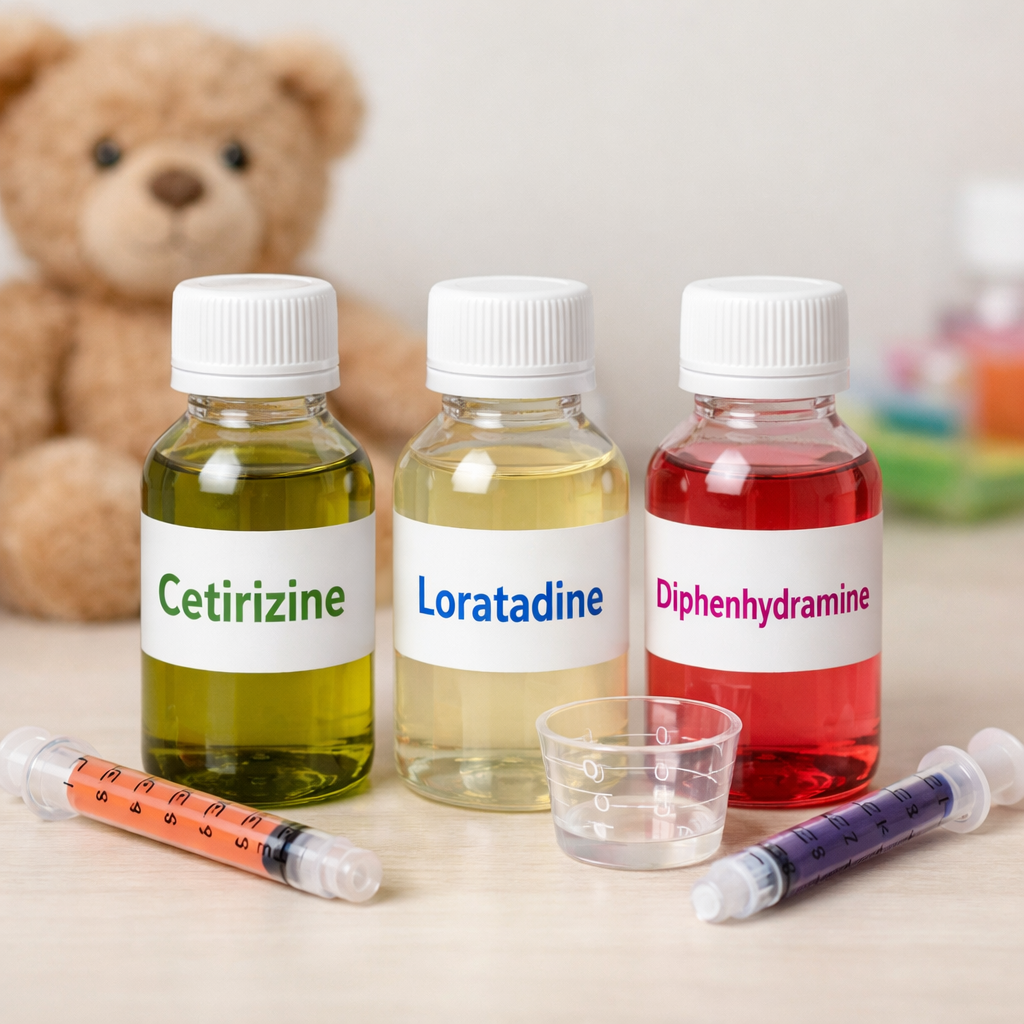
| Cetirizine (liquid) | Faster (20–60 min) | Low–moderate | Faster relief with 24‑hour coverage; hives flares |
| Loratadine (liquid) | Slower (1–3 h) | Lowest | School‑day use and minimal drowsiness |
| Diphenhydramine (liquid) | Fast (15–30 min) | High | Short, acute situations under clinician guidance |
Too Allergic’s independent, clinician-reviewed stance
Too Allergic is independent and information‑only. Our comparisons are clinician‑reviewed and safety‑forward across SLIT, intranasal corticosteroids/antihistamines, and oral antihistamines. We synthesize head‑to‑head evidence and real‑world safety signals to keep choices clear and practical for families. For routine pediatric use, we prefer second‑generation liquids and advise reserving diphenhydramine for specific, supervised indications consistent with expert guidance [AAAAI expert guidance]. Always confirm dosing and treatment plans with your pediatric clinician.
Comparison criteria
We evaluate options by:
- Onset and duration of action
- Drowsiness and cognitive effects
- Pediatric age guidance
- Effectiveness for key symptoms
- Adverse effects and cautions
- Cost and availability
Sedation, in plain language: a medicine’s tendency to cause sleepiness or slowed thinking. With antihistamines, sedation occurs when the drug enters the brain and blocks histamine’s role in alertness. First‑generation drugs are strongly sedating; second‑generation agents are designed to minimize this effect [Clinical Pharmacology of Antihistamines].
Anticholinergic effects, in plain language: side effects such as dry mouth, constipation, blurred vision, and confusion caused by blocking acetylcholine. These are common with first‑generation antihistamines and minimal with second‑generation options [Clinical Pharmacology of Antihistamines].
Sources that inform our comparisons include onset/duration ranges from GoodRx, sedation and head‑to‑head signals from the OHSU review, and practice‑based recommendations from AAAAI [GoodRx comparison of loratadine vs cetirizine] [OHSU comparative effectiveness review] [AAAAI expert guidance].
Cetirizine
Cetirizine often shines for kids who need faster non‑drowsy allergy relief: it typically starts in 20–60 minutes and provides once‑daily coverage. It’s generally well‑tolerated, though mild drowsiness can occur and appears more common than with loratadine in comparative summaries [GoodRx comparison of loratadine vs cetirizine]. In real‑world safety reports, somnolence was signaled more often with cetirizine (2,556 reports; ROR 10.52) than loratadine (1,200; ROR 7.76) [FAERS analysis of oral antihistamines]. Cetirizine is primarily eliminated by the kidneys, so dosing caution is warranted in renal impairment [Clinical Pharmacology of Antihistamines]. It has been available over the counter in the U.S. for well over a decade, improving access for families.
Loratadine
Loratadine is the go‑to when daytime alertness matters most. It typically takes 1–3 hours to kick in but offers once‑daily dosing with a low likelihood of drowsiness, making it a strong fit for school and activities [GoodRx comparison of loratadine vs cetirizine]. In pharmacovigilance data, loratadine showed a rhinorrhea association (n=326; ROR 6.75) and, notably for caregivers, more accidental child exposures and extra doses than cetirizine—signals to double‑check labels and lock storage (accidental exposures n=1,052, ROR 242.68; extra doses n=1,380 vs 406 for cetirizine) [FAERS analysis of oral antihistamines]. Loratadine is extensively metabolized via CYP3A4 and CYP2D6, so potential drug interactions should be reviewed with a clinician [Clinical Pharmacology of Antihistamines]. It has been widely available OTC since the early 2000s.
Diphenhydramine
Diphenhydramine (Benadryl) acts quickly but lasts only 4–6 hours and is strongly sedating with notable anticholinergic and cognitive effects. It appears in 300+ OTC products and remains widely used—factors that increase the risk of duplicative dosing or misuse [CNN report on diphenhydramine risks]. Recent expert recommendations favor safer, second‑generation alternatives for routine allergy control in kids; diphenhydramine may have a similar onset to cetirizine for mild reactions but causes much more sedation and should be reserved for specific, supervised indications [AAAAI expert guidance]. In older adults, a single dose can persist up to 18 hours—underscoring its potency and the need for household safety around kids and caregivers [KCRA coverage on moving Benadryl behind the counter].
Side-by-side comparison
Onset and duration
| Medicine | Onset | Typical duration |
|---|---|---|
| Cetirizine (liquid) | 20–60 minutes | ≈24 hours |
| Loratadine (liquid) | 1–3 hours | ≈24 hours |
| Diphenhydramine (liquid) | ~15–30 minutes | ~4–6 hours |
Ranges synthesized from clinical and consumer drug data [GoodRx comparison of loratadine vs cetirizine].
Best‑for snapshot:
- Need fastest and all‑day: cetirizine.
- Least drowsy daytime: loratadine.
- Short, acute situations with clinician guidance: diphenhydramine.
Drowsiness and cognitive effects
Second‑generation antihistamines reduce sedation and have minimal anticholinergic effects compared with first‑generation drugs [Clinical Pharmacology of Antihistamines]. Cetirizine is more likely than loratadine to cause drowsiness in comparative summaries, and some studies note higher sedation with cetirizine versus loratadine or fexofenadine [OHSU comparative effectiveness review]. Diphenhydramine carries strong sedation and cognitive impairment risks; avoid it for routine daytime control when safer alternatives suffice [CNN report on diphenhydramine risks].
Pediatric age guidance and safety
Many second‑generation liquids are favored for children, with some formulations labeled for infants as young as 6–24 months; always check the specific product’s age guidance and confirm dosing with a clinician. Given its ubiquity across 300+ OTC products, diphenhydramine poses higher household risk for accidental duplication; several pharmacy leaders support moving it behind the counter to enable safer recommendations [KCRA coverage on moving Benadryl behind the counter]. Parent safeguards: choose an age‑appropriate liquid, use a dosing syringe, lock medicines away, and confirm dosing with a clinician for children under 6.
Effectiveness for common symptoms
Both cetirizine and loratadine treat respiratory and skin allergic diseases, including allergic rhinitis and urticaria, with broadly similar overall efficacy across newer agents in most reviews [FAERS analysis of oral antihistamines]. Evidence is mixed head‑to‑head: one analysis favored loratadine for total symptom score, but differences are small and patient response varies—so weigh speed versus sedation for your child [OHSU comparative effectiveness review]. Quick mapping:
- Faster relief/hives flares: cetirizine.
- Daytime school focus/minimal drowsiness: loratadine.
- Acute reactions under guidance: diphenhydramine.
Adverse effects and cautions
- FAERS signals to know:
- Cetirizine: somnolence n=2,556 (ROR 10.52); attention disturbance n=233 (ROR 3.3).
- Loratadine: rhinorrhea n=326 (ROR 6.75); more accidental child exposures (n=1,052, ROR 242.68) and extra doses (n=1,380) than cetirizine (406) [FAERS analysis of oral antihistamines].
- First‑generation risks: strong sedation, anticholinergic effects, and cognitive impairment—particularly with diphenhydramine [Clinical Pharmacology of Antihistamines] [CNN report on diphenhydramine risks].
- Practical cautions: check CYP3A4/2D6 interactions with loratadine, adjust cetirizine in renal impairment, and avoid duplicating ingredients across combination cold/allergy products.
Cost and availability
Diphenhydramine liquids are often cheapest at the register but can be less cost‑effective due to short duration and side effects. Economic models in adults sometimes favor cetirizine at lower willingness‑to‑pay thresholds, with newer agents preferred in some scenarios—reminders to look beyond sticker price to daily function and safety [Cost‑effectiveness analysis of second‑generation antihistamines]. Also note availability context: diphenhydramine’s presence in 300+ OTC products raises accidental duplicate‑dosing risk [KCRA coverage on moving Benadryl behind the counter].
Value snapshot:
| Option | Price per dose | Doses/day | Likely impact on daytime function |
|---|---|---|---|
| Cetirizine | Low–moderate (generic) | 1 | Low sedation for most; monitor |
| Loratadine | Low–moderate (generic) | 1 | Least sedation; strong fit for school |
| Diphenhydramine | Low | 3–4 | High sedation; avoid for routine daytime use |
Practical recommendations
- For routine seasonal allergies or hives, start with a second‑generation liquid: choose cetirizine for faster relief or loratadine for the least daytime drowsiness [Clinical Pharmacology of Antihistamines] [GoodRx comparison of loratadine vs cetirizine].
- Reserve diphenhydramine for short‑term, specific indications under clinician direction; avoid for school‑day symptoms [AAAAI expert guidance] [CNN report on diphenhydramine risks].
- Mini action plan: dose nightly for 2–3 days, track relief and any drowsiness, shift to evening or switch agents if sedation appears, and recheck with your pediatrician if symptoms persist or your child is under 6.
When to use nasal sprays or SLIT instead of liquids
“SLIT (sublingual immunotherapy) places allergy extracts under the tongue to retrain immune responses over months to years, reducing symptom severity and medication needs for specific allergens.” Consider intranasal corticosteroids or intranasal antihistamines for moderate–severe congestion or when daily oral antihistamines aren’t enough; for nasal symptoms, these often outperform oral antihistamines. Position SLIT for confirmed triggers and long‑term control when symptoms recur each season despite correct OTC use. Too Allergic compares these options side‑by‑side to make trade‑offs clear. Confirm candidacy and timing with a clinician.
Safety tips and dosing checkpoints
- Use a dosing syringe, verify the concentration (mg/mL), and follow weight/age instructions on the label; avoid adult combination products.
- Store medicines locked away; remember diphenhydramine appears in 300+ OTC products—common source of accidental duplication [KCRA coverage on moving Benadryl behind the counter].
- Call your clinician for: symptoms persisting after 3–5 days, wheezing or breathing difficulty, hives with swelling, or frequent need for diphenhydramine.
Frequently asked questions
What’s the best liquid allergy relief for kids?
For most children, a second‑generation liquid is best: pick cetirizine for faster relief or loratadine for less daytime drowsiness, and confirm dosing with your pediatrician. Too Allergic’s quick chooser can help you weigh those trade‑offs.
Is cetirizine or loratadine better for daytime school and activities?
Loratadine is typically less sedating and fits school days well; cetirizine is a strong alternative if faster relief is needed. Too Allergic’s comparison table summarizes the differences.
When is diphenhydramine appropriate for children?
Reserve diphenhydramine for short‑term, specific situations under clinician direction—it’s strongly sedating and not ideal for routine daytime control. Too Allergic flags it for limited, supervised use.
How fast do these liquids work and how long do they last?
Cetirizine works in 20–60 minutes and lasts ~24 hours; loratadine starts in 1–3 hours and also lasts ~24 hours; diphenhydramine starts faster but wears off in 4–6 hours. Too Allergic lists typical onset and duration ranges to set expectations.
What age can children start these antihistamines and how should dosing be verified?
Age cutoffs vary by product; always check the specific bottle’s guidance and confirm the dose with your pediatric clinician. Too Allergic’s pediatric content links to age labeling and dosing basics.
Talk with a clinician before starting or switching therapy
Too Allergic is an independent, information‑only resource with clinician‑reviewed content—we do not provide or sell care. Always confirm diagnosis, age‑appropriate dosing, and potential interactions with a clinician, especially under age 6, in chronic conditions, or when considering SLIT or intranasal therapies. For deeper guidance, see our pediatrician‑reviewed overview of non‑drowsy options and 24‑hour relief and our ranked comparison of daily pediatric antihistamines:
- Pediatrician‑reviewed guide to non‑drowsy, 24‑hour kids’ allergy relief: https://www.tooallergic.com/pediatrician-reviewed-guide-to-non-drowsy-24hour-kids-allergy-relief/
- Ranked comparison of daily pediatric antihistamines: https://www.tooallergic.com/top-7-pediatric-antihistamines-ranked-for-daily-allergy-control/