
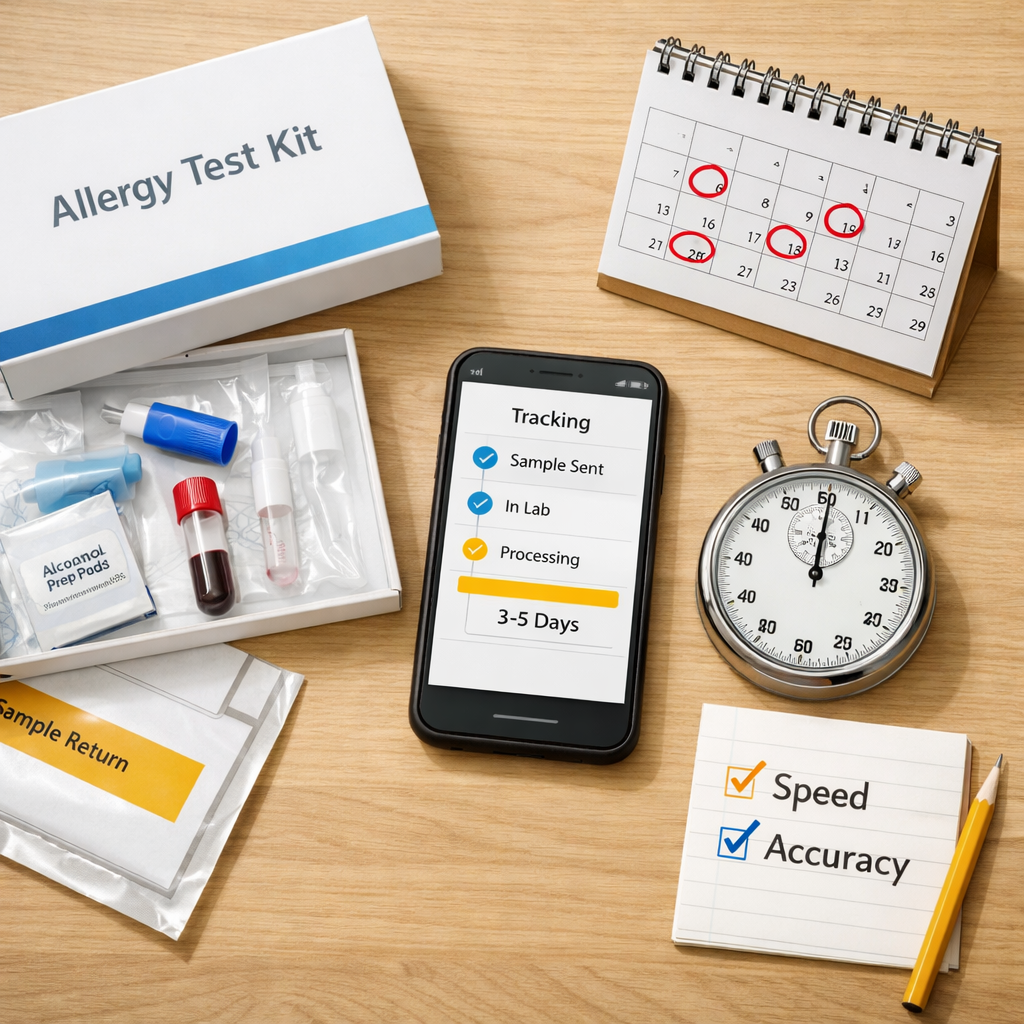
At-Home Allergy Test Speed Guide: Realistic Timelines and Tradeoffs
If you want the fastest allergy “result,” context matters. In clinic, a skin prick test is read in 15–20 minutes, but it requires scheduling and a visit. At home, the quickest practical option is a finger‑prick IgE mail‑in panel; most people get a digital report a few days to about two weeks after the lab receives the sample. That’s fast for a report—but not the same as a confirmed diagnosis. This guide sets realistic timelines, explains where delays happen, and shows when it’s worth waiting for clinic testing to make safer decisions, especially for kids and food allergy. Too Allergic helps you weigh speed versus safety so you can plan next steps with fewer surprises.
Quick answer to speed
- Fastest immediate readout: clinic skin prick testing, read in 15–20 minutes via wheal/flare, with results interpreted during the visit (source: skin prick testing overview) (skin prick testing is read in 15–20 minutes).
- Fastest at‑home report: IgE finger‑prick mail‑in panels, typically a few days to ~2 weeks after the lab receives your sample (source: industry overview) (allergy testing innovations).
Time-to-report is how fast you get a result file. Time-to-decision is how fast you can make a safe, actionable choice (diet change, prescription, immunotherapy). Clinic testing often shortens time-to-decision because interpretation happens on the spot or is paired with confirmatory steps.
| Fastest immediate readout | Fastest at-home report |
|---|---|
| Clinic skin prick test (15–20 minutes) | IgE finger‑prick mail‑in panel (days after lab receipt) |
What counts as a “result” and why timelines vary
“Result” can mean the first visible test outcome (such as a skin reaction), a finalized lab report, or a clinically confirmed diagnosis. At‑home kits usually deliver lab reports; clinics can provide same‑day interpretations but may still need confirmatory testing—especially for food allergy—to translate findings into safe, actionable decisions.
Timelines vary because of:
- Sample type and method (finger‑prick blood vs. saliva vs. hair; some methods lack validation) (at‑home kits and limitations).
- Shipping and lab workflow for mail‑in kits (allergy testing innovations).
- Clinic appointment availability and prep, including medication washout for skin tests (skin prick testing is read in 15–20 minutes).
- Validation steps like an oral food challenge for high‑stakes foods (skin prick testing is read in 15–20 minutes).
How at-home allergy tests work
Most kits follow a simple flow: you order a kit, collect a finger‑prick blood sample at home, mail it to a certified lab, and receive a digital report once analysis is complete. The main bottlenecks are shipping and lab capacity (allergy testing innovations). In our guides, Too Allergic prioritizes validated IgE blood methods over hair or saliva approaches.
IgE (40–50 words): Immunoglobulin E is the antibody class that mediates immediate-type allergic reactions. Measuring allergen‑specific IgE indicates sensitization to that allergen, not necessarily clinical allergy. Diagnosis requires correlating test results with a compatible symptom history and, for food allergy, sometimes adding confirmatory testing (skin prick testing is read in 15–20 minutes).
IgG (40–50 words): Immunoglobulin G reflects exposure and immune tolerance patterns over time. Panels marketed as “food sensitivity” tests based on IgG are not accepted as diagnostic for allergy, and positive findings can simply mark habitual intake rather than disease, risking unnecessary restrictions (at‑home kits and limitations).
Caution: Some kits use hair or saliva. Evidence supporting these sample types for diagnosing allergies is weak; they may be fast but can mislead decisions (at‑home kits and limitations).
Realistic timelines by test type
Below are typical windows from collection to report, plus what’s usually required to reach a confident decision.
| Test type | Collection time | Lab/reading time | Typical report window | Notes/validation needs |
|---|---|---|---|---|
| At‑home IgE finger‑prick panel | 10–20 minutes at home | Lab analysis | Few days to ~2 weeks after lab receipt | Sensitization only; correlate with symptoms; consider follow‑up (allergy testing innovations; at‑home kits and limitations) |
| Clinic skin prick test (SPT) | 10–15 minutes in clinic | 15–20 minutes reading | Same day | High sensitivity; positives need clinical correlation; antihistamine washout often required (skin prick testing is read in 15–20 minutes) |
| Serum specific IgE (clinic lab) | Standard blood draw | Lab analysis (often ELISA) | Few days | Useful if SPT not feasible; can add component‑resolved diagnostics for specificity (component‑resolved diagnostics) |
| Patch test (contact dermatitis) | Placement visit | 48 hours on skin; reads over 48–96 hours total | Interpreted across 2–3 visits | For delayed contact reactions (metals, fragrances); not IgE‑mediated (at‑home kits and limitations; skin prick testing is read in 15–20 minutes) |
| Supervised oral food challenge | Half‑day appointment | Same‑day monitoring | Same day | Gold standard to confirm/rule out food allergy; specialist oversight due to risk (skin prick testing is read in 15–20 minutes) |
Tip: If you can’t stop antihistamines, ask about a serum specific IgE blood test; labs typically return results in days and can be paired with component testing to sharpen specificity (component‑resolved diagnostics).
At-home IgE finger-prick panels
Expect a simple collection, prepaid return mail, and a digital report in a few days to about two weeks after the lab receives your sample. Turnaround hinges on shipping speed and lab load. Reports show sensitization, not definitive allergy; false positives and negatives occur, so interpret alongside your symptom history (at‑home kits and limitations).
For high‑stakes foods, plan a clinician follow‑up to consider confirmatory testing before changing diets. See our practical picks and caveats in Too Allergic’s guide to affordable kits under $150: top-rated, affordable home allergy tests.
At-home IgG “sensitivity” panels
IgG‑based “food sensitivity” panels are not accepted for diagnosing allergy and may mostly reflect exposure patterns. They’re quick to buy and collect but can delay the right next step if over‑interpreted. Don’t impose broad restrictions—especially for kids—without clinical guidance. Hair or saliva versions add more uncertainty (at‑home kits and limitations). Too Allergic treats IgG panel outputs as non‑diagnostic context only.
Clinic skin prick test
SPT provides a same‑day read (15–20 minutes) by measuring wheal/flare reactions to tiny allergen pricks. It’s highly sensitive for many inhalants and some foods, but specificity is limited—positives need context and sometimes confirmation. Clinics often advise stopping antihistamines beforehand for accuracy (skin prick testing is read in 15–20 minutes).
Clinic patch test for contact allergy
Patch testing targets delayed contact dermatitis (e.g., metals, fragrances, preservatives), not immediate IgE reactions. Allergens are worn for 48 hours, with readings over 48–96 hours and multiple visits. Plan calendar time for placement and follow‑up reads (at‑home kits and limitations).
Serum specific IgE in clinic
When skin testing isn’t feasible (dermatographism, medications, eczema flares), serum specific IgE is a good alternative. Modern platforms quantify multiple allergens and can add component‑resolved diagnostics to reduce cross‑reactivity and improve specificity for select foods (component‑resolved diagnostics).
Supervised oral food challenge
Oral food challenges are the gold standard to confirm or rule out food allergy and must be performed under specialist supervision due to anaphylaxis risk. Expect a half‑day visit and variable scheduling lead times. Prior SPT, serum IgE, and components help select candidates and dose plans (skin prick testing is read in 15–20 minutes).
Speed versus accuracy tradeoffs
- Performance data: Reviews report SPT sensitivity around 90–94% for certain foods, while specificity can hover near ~50% with larger wheals—useful for ruling in sensitization but imperfect for diagnosis; combining SPT with serum sIgE can boost specificity at the expense of some sensitivity (review data on SPT sensitivity and specificity).
- CRD advantage: Component‑resolved diagnostics can pinpoint culprit proteins (e.g., storage proteins vs. cross‑reactive pollens), improving specificity and reducing unnecessary avoidance (component‑resolved diagnostics).
- At‑home reality: Kits are quick to start but may be less thorough; some rely on unvalidated sample types, raising false‑positive/negative risk and stretching the time-to-decision if you need confirmation (at‑home kits and limitations).
Interpreting results without overreacting
- Start with history: Match reported sensitizations to actual exposures and symptoms.
- If mismatch or high stakes (e.g., staples in a child’s diet), book a clinician visit before changing diets.
- Don’t over‑interpret total IgE; it reflects overall antibody levels and doesn’t identify specific triggers (expert insights on at‑home test accuracy).
- Keep a brief symptom diary aligned with exposures to speed clinic interpretation. For help focusing options, see our parent checklist: common mistakes parents make when selecting kids’ allergy tests.
When fast is not fast enough and you should see a clinician
- Seek in‑person care for severe reactions, pediatric cases, asthma complicators, or when results will change management (e.g., immunotherapy) or require an oral food challenge.
- Positive at‑home results alone shouldn’t trigger strict avoidance without clinical correlation. Kits can be cheaper and convenient but are often less comprehensive than clinic pathways (at‑home kits and limitations).
- Expect antihistamine washout guidance before SPT, which may add scheduling lead time (skin prick testing is read in 15–20 minutes).
Practical tips to shorten your end-to-end timeline
- At‑home kits: Collect and mail the same day; use tracked or expedited return if offered; pre‑book a follow‑up visit to overlap shipping and lab time.
- Clinic testing: If you can’t stop antihistamines, ask about serum sIgE as a bridge; bring a concise exposure/symptom log to speed decisions.
- Patch testing: Block your calendar for placement and 48–96‑hour reads to minimize work/school disruption.
- Shopping smart: Compare kits, lab credentials, and turnaround in our buyer’s guides: top at‑home allergy tests for kids and virtual allergy clinics compared.
What’s coming next in faster allergy testing
- Higher‑specificity bloodwork: Broader component panels and multi‑allergen ELISA platforms aim to deliver quicker, more actionable specificity in days (component‑resolved diagnostics).
- Functional assays: The Basophil Activation Test shows promise in select contexts (e.g., certain drugs), though access and standardization remain hurdles (allergy testing innovations).
- Real‑time sensing: Wearables and portable allergen sensors are emerging, but costs and reimbursement may limit adoption in the near term (allergy diagnostics market research).
- Market outlook: Reports suggest North America currently leads the home testing kits market, yet accuracy limits and regulation remain headwinds (home allergy testing kits market).
Frequently asked questions
Which home allergy test provides the fastest results?
At‑home IgE finger‑prick mail‑in panels typically deliver reports within a few days to about 2 weeks after the lab receives your sample. If you need same‑day insights, clinic skin prick testing shows results in 15–20 minutes; Too Allergic’s guides can help you decide which path fits your timeline.
How long do mail-in allergy tests really take from order to report?
Most people see results 3–14 days after the lab receives their sample; shipping time and lab workload are the main variables, so mailing the kit back the same day and using any expedited return option can shorten the wait. Too Allergic’s checklists can help you shave days off the process.
Are at-home IgG food sensitivity tests useful for speed or accuracy?
They’re fast to purchase and complete but aren’t accepted as diagnostic for food allergy. Too Allergic recommends treating them as non‑diagnostic context and following up with a clinician before major diet changes.
Do medications affect timing or accuracy of clinic skin tests?
Yes—antihistamines can blunt skin prick responses, so clinics often ask you to stop them; if you can’t, a serum specific IgE blood test may be used instead. Too Allergic’s guides explain when that bridge makes sense.
How should I use at-home results to plan next steps safely?
Match results to your symptom history, avoid over‑restricting foods—especially for kids—and book a clinician visit for confirmation when results are unclear or high stakes. Too Allergic’s prep tools help you focus questions and speed the visit.
Medical disclaimer and safety reminder
This guide is informational and not medical advice. Too Allergic is an independent, parent‑led resource. Always confirm testing choices, medication changes, and diagnosis with a licensed clinician. For severe or pediatric reactions, seek in‑person allergy care promptly.