
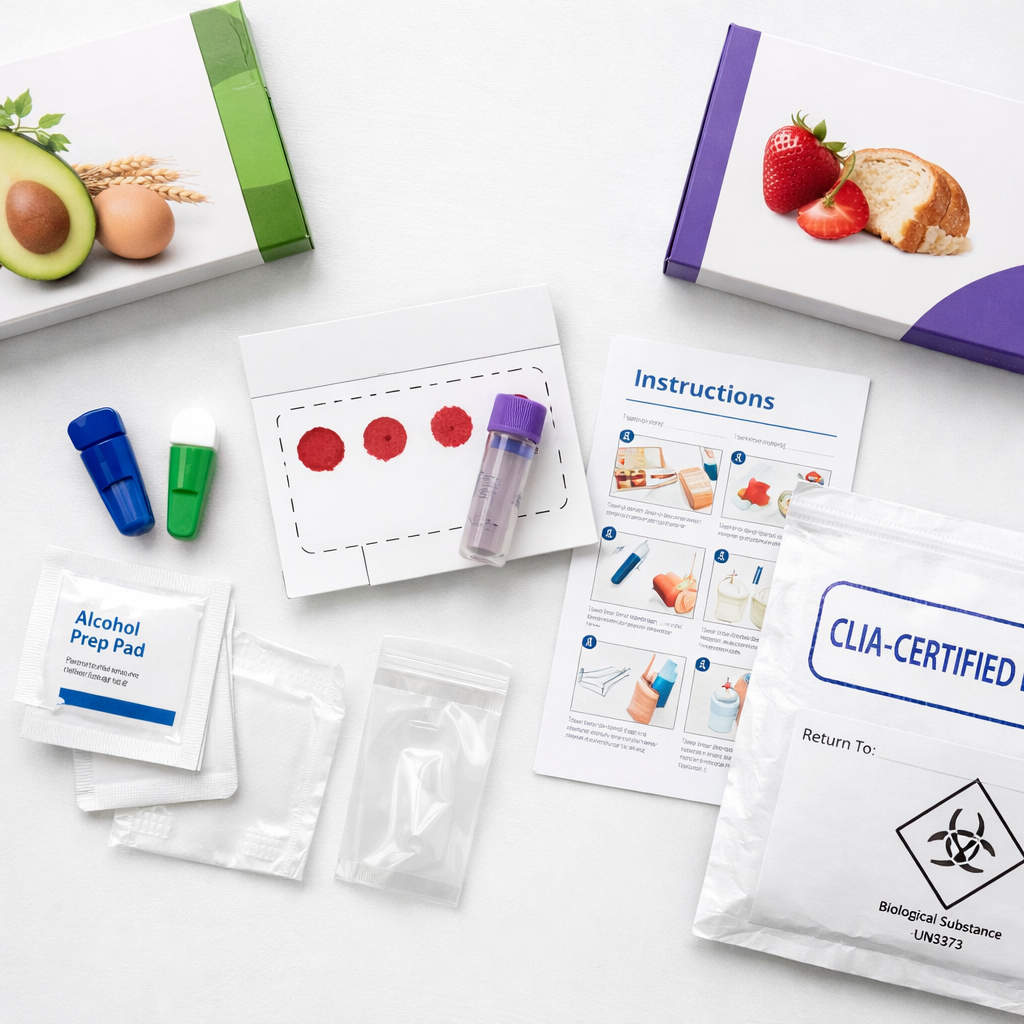
7 Best-Rated Food Sensitivity Test Kits from CLIA-Certified Labs
If you’re comparing home allergy test kits for food sensitivities, the best-rated options generally fall into three buckets: IgG blood panels, hydrogen/methane breath testing for FODMAP-related intolerance, and DNA-based intolerance screens. Below, we round up leading kits that use or claim CLIA‑certified labs where applicable, flag who they fit best, and highlight how fast results come back. Important caveat: IgG “food sensitivity” tests are controversial and not FDA‑cleared diagnostics; experts have called them medically dubious when used to diagnose intolerance, so treat results as hypotheses to guide a supervised elimination diet, not definitive answers (see STAT’s analysis of Everlywell’s panel) [STAT News review].
Comparison snapshot (features at a glance)
| Kit | What it measures | Foods covered | Sample | Claimed CLIA status | Typical turnaround | Price | Notable support | Best for |
|---|---|---|---|---|---|---|---|---|
| Everlywell | IgG reactivity | 96 or 204 foods | Finger‑prick dried blood | Yes (partner labs) | ~3–5 days | $199 / $299 | Physician-reviewed, HIPAA-compliant report; not sold in NY | Fast, broad first-pass IgG screen |
| myLAB Box | IgG reactivity | ~96 foods | Finger‑prick blood | Varies by panel | ~3–12 days (variable) | Lower than many peers | Budget pick per independent testers | Cost-conscious IgG users who can wait |
| Pinnacle BioLabs FIT | IgG microarray | Up to 200 foods | Small blood drop | Noted lab-based panel | ~1–2 weeks (typical for microarrays) | Higher ($$–$$$) | “One‑drop” microarray positioning | Breadth-focused IgG mapping |
| Gene Food | Genetic intolerance markers | NA (genes, not foods) | Cheek swab | Claims CLIA lab processing | ~2–3 weeks | Varies | Diet-type guidance; not IgG | DNA-first narrowing of diet trials |
| 5Strands | Bioresonance sensitivity | 300+ lifestyle items (varies) | Hair | Not a CLIA assay | ~2–3 weeks | ~$83–$136 ranges cited | Human + pet options | Broad exploratory signal + journaling |
| FoodMarble (AIRE/AIRE 2) | Hydrogen ± methane breath | Food components (FODMAPs) | Breath | Device-based, not CLIA lab | ~3 minutes per test | Kit $39; device extra | App-led FODMAP plan; Discovery program | Real-time IBS/SIBO/FODMAP guidance |
| “Life” and other FIT microarrays | IgG microarray | ~150–220 foods | Blood | Varies by brand | ~1–2 weeks | $$–$$$ | Often used by DTC/clinics | Comprehensive IgG mapping with caveats |
Sources: Independent testing roundups naming Everlywell “best overall” and myLAB Box “best budget,” plus breath-testing picks and turnarounds [Independent roundup]; Everlywell’s product specs and lab claims [Everlywell product page]; external timing notes on Everlywell [Everlywell timing review]; Pinnacle BioLabs microarray positioning [PBLabs microarray]; 5Strands pricing and reach [5Strands overview]; FoodMarble device/kit details [FoodMarble kit page]. IgG validity cautions from clinical commentators [STAT News review] and genetics-first perspectives [Gene Food critique].
Too Allergic
We’re an independent, family-led, safety-first guide. Our editorial stance: use at-home results to organize a thoughtful elimination/reintroduction plan and to prepare smarter conversations with licensed clinicians. We do not sell tests; we evaluate them, focusing on safe next steps and clear follow-up. We cover food, pet, and nickel allergies, non-drowsy antihistamines, pediatric intranasal steroids, exposure reduction, and practical telehealth navigation. For deeper comparisons and kid-specific tips, see our user-rated roundup of at-home kits and our pediatric testing guide on Too Allergic.
Disclaimer
- Not medical advice. Use test results as conversation-starters with your child’s clinician or allergist. Plan follow-up to confirm or refute findings.
Everlywell
Everlywell remains the most recognized IgG panel for first-pass screening. Independent reviewers name it “best overall” and “most comprehensive,” with simple finger-prick dried blood spots covering 96 or 204 foods; purchaser support includes physician-reviewed reporting and HIPAA compliance, but it’s not available in New York per review testing [Independent roundup]. Everlywell confirms CLIA‑certified partner labs and IgG panels at $199 (96 foods) or $299 (204 foods) [Everlywell product page]. Turnaround is typically 3–5 days from lab receipt—faster than many peers according to third-party testing notes [Everlywell timing review].
How to use it safely
- At Too Allergic, we treat elevated IgG as a shortlist for a supervised elimination and structured reintroduction; experts have criticized IgG food panels as medically dubious and not FDA‑regulated diagnostics [STAT News review].
- Consider starting with 1–3 top foods for a four-week trial before expanding.
myLAB Box
For budget-focused households, myLAB Box’s ~96‑food IgG panel is frequently highlighted as a value pick. Testers report eligibility for ages 14+ and variable lab times—about 3 to 12 days—so set expectations accordingly [Independent roundup]. It’s a practical option if price is pivotal and you already plan clinician follow-up to interpret IgG reactivity.
Best fit
- Cost-conscious users who can tolerate variable turnaround and will validate findings through an elimination diet and, if needed, clinical testing—consistent with Too Allergic’s safety-first approach.
Pinnacle BioLabs FIT
Pinnacle’s approach uses a microarray to map IgG reactivity to as many as 200 foods, marketed as “one-drop-of-blood” comprehensive testing [PBLabs microarray]. Microarrays offer broader coverage than 96‑food panels but often at higher cost and with longer turnaround.
Breadth vs. actionability
- More foods do not equal higher clinical validity—IgG outputs remain hypotheses. Prioritize changes that are feasible, nutritionally safe, and symptom-aligned before chasing long lists.
Gene Food
Gene Food focuses on genetic intolerance markers (not IgG) processed in a lab environment with CLIA claims and a typical 2–3 week timeline. The company and independent commentators argue for ruling out true allergy and genetically mediated intolerance (e.g., lactase persistence, celiac risk) before trying IgG panels, which they view as weakly supported [Gene Food critique]. Pair DNA insights with clinician-ordered confirmatory tests when symptoms suggest enzyme-related or autoimmune pathways.
When to use genetics first
- Family history of lactose intolerance, celiac risk, or recurrent post-dairy/post-gluten symptoms that warrant targeted screening.
5Strands
5Strands provides broad “intolerance/sensitivity” profiles for humans and pets, reporting selection by hundreds of thousands of users and price points often cited around ~$83–$136 for popular bundles [5Strands overview]. Methodology differs from immunoassays: many panels use bioresonance on hair samples rather than CLIA‑validated serology.
How to use responsibly
- Confirm the method before purchase and pair results with a symptom journal and supervised diet trials. Avoid large unsupervised eliminations—especially for kids.
FoodMarble
Breath testing helps when your main concern is IBS/SIBO/FODMAP‑type bloating or suspected malabsorption. Independent reviewers rate FoodMarble best for IBS/SIBO/FODMAP exploration; AIRE measures hydrogen only, while AIRE 2 measures hydrogen plus methane. Hydrogen breath testing has been used clinically since the 1970s, and FoodMarble’s app returns readings in about three minutes with FODMAP guidance and a staged six‑week Discovery plan [Independent roundup; FoodMarble kit page].
Why choose it
- Rapid, meal-by-meal feedback and structured reintroduction for suspected lactose or fructose malabsorption—often a better first step than IgG panels when gas and bloating dominate.
Life and other FIT microarrays
Beyond Pinnacle, many DTC services and some clinics use similar 150–220‑food IgG microarrays marketed for comprehensive mapping [PBLabs microarray]. Expect:
- Panel size: typically 150–220 foods
- Sample: finger-prick or small blood draw
- Turnaround: roughly 1–2 weeks
- Price band: mid-to-high ($$–$$$)
- Report depth: numerous food categories with tiered reactivity
Caveat: Even with “comprehensive” footprints, IgG remains hypothesis-generating; act on a short, strategic subset rather than over-restricting.
What CLIA certification means for home test kits
CLIA certification indicates a lab meets federal quality standards for testing processes, personnel, and proficiency. It does not, by itself, validate a specific test’s clinical accuracy or FDA clearance. Many at-home IgG panels are lab-developed tests and not FDA-regulated diagnostics [STAT News review].
What CLIA covers (and doesn’t)
- Covers: lab operations, quality systems, proficiency testing
- Doesn’t: prove clinical utility of IgG for intolerance
- Verify: look for CLIA language on brand pages and confirm whether the specific panel is processed in a CLIA‑certified facility
Too Allergic reviews flag whether a panel discloses CLIA processing and how results should be used safely.
Food allergy vs food sensitivity vs intolerance
- Food allergy (IgE-mediated): An immune reaction that can trigger immediate symptoms and anaphylaxis. Diagnosis often uses specific IgE testing or oral food challenges in clinics; results drive strict avoidance and emergency planning.
- Food sensitivity (often used for IgG): A non-standardized term for delayed or variable reactions. IgG panels detect antibodies but lack strong clinical support for diagnosing intolerance; use findings to guide supervised elimination trials, not permanent avoidance [STAT News review; Gene Food critique].
- Food intolerance (non-immune): Difficulty digesting components like lactose or fructose, commonly evaluated with hydrogen or methane breath tests; hydrogen breath testing has been used clinically since the 1970s [Independent roundup].
Quick map of tests and next steps
| Test type | Sample | Best next step |
|---|---|---|
| Clinic IgE allergy testing | Blood or skin prick | Allergist-guided plan; consider oral food challenge if appropriate |
| IgG sensitivity panel (DTC) | Finger-prick blood | Targeted 4‑week elimination + structured reintroduction; consider confirmatory clinical tests |
| Hydrogen/methane breath test | Breath | Adjust FODMAPs; confirm with clinician if severe/persistent symptoms |
| Genetic intolerance screen | Cheek swab | If positive, pursue clinician-ordered tests (e.g., celiac serology, lactose breath test) |
How to choose a kit for your household
- Step 1: Match symptoms. Immediate hives/wheeze = allergy clinic. Bloating/gas/IBS = consider FoodMarble first for rapid, app-guided FODMAP insights [Independent roundup; FoodMarble kit page].
- Step 2: If opting for IgG, choose breadth vs budget. Everlywell offers fast 3–5 day turnaround and physician review signals; budget seekers may try myLAB Box but expect variable lab times [Everlywell timing review; Independent roundup].
- Step 3: If inherited intolerance or celiac/lactase issues seem likely, prioritize genetics and clinician-ordered screens before IgG; this sequencing aligns with Gene Food’s stance [Gene Food critique].
Checklist
- Budget and turnaround time
- Sample comfort (blood vs breath vs cheek swab)
- Pediatric suitability and supervision needs
- Clear plan for clinician follow-up and telehealth escalation (see our telehealth checklist on Too Allergic)
How to use results safely
- Treat IgG as a hypothesis. Many experts question its diagnostic validity; use top flags to prioritize a focused trial [STAT News review; Gene Food critique].
- Run a 4‑week elimination of 1–3 foods, then reintroduce one at a time while logging symptoms, stool patterns, and energy.
- Order confirmatory tests when indicated: specific IgE (for suspected allergy), lactose hydrogen breath testing, celiac serology, or targeted genetics—ideally coordinated with your clinician. Too Allergic favors short trials, careful reintroduction, and documented follow-up.
Family-centered cautions and when to see a clinician
- Red flags needing in-person care: immediate reactions (hives, wheeze, throat tightness), growth faltering, unintended weight loss, blood in stool, or suspected anaphylaxis.
- For kids: avoid broad unsupervised eliminations. Ask about second‑generation non‑drowsy antihistamines and pediatric intranasal steroids for allergic rhinitis days; focus on exposure reduction at home and school.
- Telehealth navigation: choose platforms with triage criteria and clear in‑person escalation plans; see Too Allergic’s telehealth features checklist for what to expect.
Frequently asked questions
Are at-home food sensitivity tests accurate?
Accuracy varies by method and brand; IgG panels are best treated as screening tools. On Too Allergic, we recommend using results to guide a supervised elimination plan and confirming with clinical testing when symptoms persist.
What do IgG food sensitivity results really mean?
They reflect prior exposure and possible triggers but don’t prove a clinical sensitivity. Too Allergic advises using them to prioritize a short, monitored elimination with clinician input.
How are these tests different from true food allergy testing?
Allergy testing targets IgE-mediated reactions that can be immediate and severe, often confirmed in clinics. At Too Allergic, we treat sensitivity kits—especially IgG—as organizational aids for elimination diets, not stand‑alone diagnostics.
Can kids use at-home kits safely?
Some kits allow teen self-collection, but children need clinician oversight to avoid nutritional gaps. Too Allergic recommends starting with symptom tracking and pediatric guidance before removing multiple foods.
Will insurance, HSA, or FSA cover these tests?
Coverage is inconsistent. Too Allergic suggests verifying HSA/FSA eligibility with your plan and budgeting for clinician follow-up.