2026 Buyer’s Guide to Home Allergy Tests for Kids: Top Pick
Parents want safe, fast answers—especially when sneezing, rashes, or mealtime fears derail daily life. Here’s the bottom line: clinic-based methods remain the diagnostic standard for kids. Skin prick testing (SPT), clinician-ordered serum IgE, component‑resolved diagnostics (CRD), and oral food challenges (OFC) establish what’s truly an allergy, while at-home IgE kits can serve as a convenient preliminary screen for environmental triggers—not for diagnosing food allergy, ever. The evidence base is clear on why interpretation matters and why missteps lead to unnecessary restrictions and anxiety, particularly in children, as summarized in the AllergyX guide to pediatric allergy testing (methods, accuracy, and risks) and typical costs (SPT $60–$300, OFC $1,000–$3,000) AllergyX pediatric testing overview.
Bottom line for busy parents: For itchy eyes, sniffling, or pet/pollen concerns, a CLIA‑certified at‑home IgE environmental screen can help you decide whether to book an allergy visit sooner. For any food concern, skip home kits—go straight to clinician‑ordered testing and consider an OFC if results affect safety or nutrition. See the stepwise plan in Stepwise path to a reliable diagnosis.
How home allergy tests for kids work
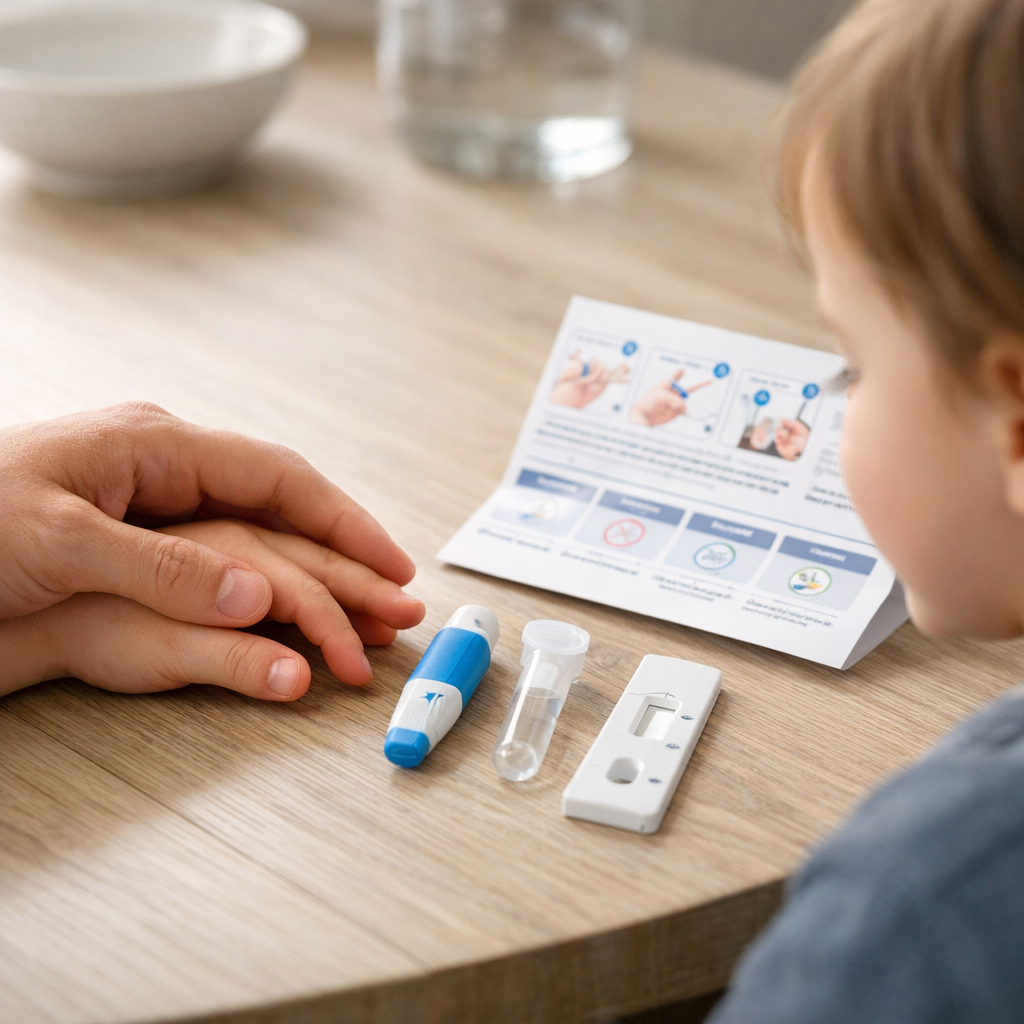
An at-home IgE kit typically uses a finger-prick to collect a small blood spot that you mail to a certified lab. The lab measures IgE antibodies to selected allergens and returns digital results within days, often priced $150–$400 and rarely covered by insurance, per consumer guides and vendor policies described in Healthline’s overview of at‑home allergy tests Healthline on at-home allergy tests.
Turnaround is commonly 1–7 days for lab-based IgE reports, depending on the vendor and panel size. Some platforms also include PDFs you can share with your child’s clinician.
Families value privacy and speed, but convenience comes with trade-offs: results can be hard to interpret without context, false positives are common, and kits do not replicate clinic standards—points echoed in hospital explainers on home testing pros and cons Liv Hospital explainer on home testing.
What each test measures and when it’s used
Use this map to choose the right tool for the job—and to know when you need a clinic visit.
| Test | What it measures | Best use | Typical cost | Time to result | Accuracy notes |
|---|---|---|---|---|---|
| Skin prick test (SPT) | Immediate wheal from skin-level mast cell activation | Rapid clinic screening for aeroallergens and common foods | $60–$300 | 15–30 minutes | High false positives (50–60%) from cross-reactivity; needs clinician interpretation AllergyX pediatric testing overview |
| Serum specific IgE | Allergen-specific IgE in blood | When antihistamines can’t be paused; higher anaphylaxis risk | $40–$200 per allergen | 1–7 days | Not affected by antihistamines; interpret with history to avoid over-diagnosis (AAFP Choosing Wisely) AAFP guidance on allergy testing |
| Component-resolved diagnostics (CRD) | IgE to individual proteins (e.g., Ara h 2) | Risk stratification, immunotherapy planning | $400–$1,500 | 3–10 days | Higher specificity (~92% for some severe-reaction markers); still requires clinical context AllergyX pediatric testing overview |
| Oral food challenge (OFC) | Supervised ingestion and observation | Confirm or rule out food allergy | $1,000–$3,000 | 4–6 hours in clinic | Diagnostic gold standard (~95–98%); requires epinephrine availability AllergyX pediatric testing overview |
| At-home IgE kits | Finger-prick IgE to selected allergens | Preliminary environmental screening only | $150–$400 | 1–7 days | About ~60% accuracy with ~40% false positives in some 2024 reviews; not for food diagnosis (see Healthline overview above) |
| IgG “sensitivity” panels | Food-specific IgG | Not recommended for diagnosis | $150–$400+ | 1–14 days | Reflects exposure/tolerance, not allergy; can prompt harmful eliminations (AAFP, pediatric hospitals) Nationwide Children’s on at-home tests |
Safety-first guidance for children
Avoid removing major food groups from a child’s diet without medical advice; restrictive diets can impair growth and nutrition, and many “positives” are not clinical allergies, a risk highlighted in independent consumer testing reviews BBC analysis of home intolerance tests. Confirm any positive result related to foods with a pediatric allergist; if outcomes would change safety or nutrition, an OFC in clinic is appropriate.
Warning: Oral food challenges carry a measurable risk of severe reaction (about 25% require significant intervention in some series). They must be performed under specialist supervision with epinephrine immediately available AllergyX pediatric testing overview.
How we chose our top pick
At Too Allergic, we prioritized: clinical validity for pediatric screening, transparent lab methods, affordability, clear result summaries download-ready for clinicians, and easy coordination for follow-up. Current evidence shows at-home IgE kits average around ~60% accuracy with notable false positives, so our recommendation is limited to environmental screening—not for diagnosing food allergy, anaphylaxis risk, or planning elimination diets. Many kits are not insurance-covered; HSA/FSA eligibility varies by vendor and plan, per expert overviews of at-home testing coverage and accuracy Expert insights on at-home testing.
Top pick for at-home screening
Choose a CLIA‑certified at‑home IgE environmental panel with pediatric-friendly finger‑prick tools and transparent methods, ideally priced $150–$400 (popular kits often near $199). Look for downloadable PDFs suitable for clinician review and panels focused on pollen, dust mites, molds, and pet dander. Use only as a preliminary screen to triage environmental symptoms, and plan to confirm any positives with an allergist. Too Allergic prioritizes CLIA certification, child-friendly collection, and clinician-ready reporting in its comparisons. See our deeper comparison in Too Allergic’s 2026 breakdown of at‑home blood allergy tests.
Do not use for:
- Diagnosing food allergies or assessing anaphylaxis risk.
- Starting elimination diets.
- Deciding on school emergency plans without clinician input.
These are inappropriate uses because of modest accuracy (~60%) and substantial false positives (~40%) reported in some 2024 reviews (see sources linked above).
Side-by-side comparison
| Test/Tool | What it measures | Pediatric use-case | Turnaround | Cost | Accuracy/limitations | Who interprets |
|---|---|---|---|---|---|---|
| Skin prick test (SPT) | Immediate wheal from skin exposure | Quick clinic screen for aero/food | 15–30 min | $60–$300 | 50–60% false positives from cross-reactivity; needs context | Allergist in clinic |
| Serum specific IgE | Blood IgE per allergen | When SPT not feasible; high anaphylaxis risk | 1–7 days | $40–$200 per allergen | Not affected by antihistamines; sensitization ≠ allergy | Allergist/pediatrician |
| Component-resolved diagnostics (CRD) | IgE to specific proteins | Risk stratification; OIT planning | 3–10 days | $400–$1,500 | ~92% specificity for certain markers | Allergist |
| Oral food challenge (OFC) | Supervised ingestion | Confirm/rule out food allergy | 4–6 hours | $1,000–$3,000 | Gold standard (~95–98%); reaction risk | Allergist with emergency setup |
| At-home IgE kits | Finger-prick IgE | Preliminary environmental screen | 1–7 days | $150–$400 | ~60% accuracy; not for food diagnosis | Share with clinician |
| IgG panels | Food-specific IgG | Not recommended | 1–14 days | $150–$400+ | Reflect exposure/tolerance, not allergy | Avoid/ignore |
| Consumer detectors | Traces of allergens in foods/surfaces | Exposure reduction with known allergy | Seconds–minutes | ~$150–$230+ | Not diagnostic; detects cross-contact only | Caregiver with training |
Skin prick test
SPT provides in-office results in 15–30 minutes and is relatively affordable ($60–$300). False positives are common (50–60%) due to cross-reactivity—when the immune system recognizes similar proteins across sources (like birch pollen and certain fruits), provoking a positive test despite no meaningful symptoms in real life; clinician interpretation is essential. Pause antihistamines for about five days beforehand to reduce false negatives.
Clinician-ordered serum IgE
Per-allergen pricing typically runs $40–$200, while broad panels can exceed $600, with results returning in 1–7 days. Serum IgE is not affected by antihistamines and is preferred when patients are at risk of severe anaphylaxis or cannot stop medications, consistent with AAFP Choosing Wisely guidance. Sensitization (e.g., IgE >0.35 kUA/L) indicates antibody presence but does not equal clinical allergy—history still rules.
Component-resolved diagnostics
CRD measures IgE to specific allergen proteins (for example, Ara h 2 for peanut) to refine risk of systemic reactions and separate true allergy from cross-reactivity patterns. Certain components achieve ~92% specificity for predicting severe reaction risk. Costs are higher ($400–$1,500) and use is targeted: unclear histories, high‑risk foods, or planning oral immunotherapy.
Oral food challenge
OFC delivers the clearest answer (~95–98% diagnostic accuracy) but requires 4–6 hours in a clinic with emergency preparedness, costing roughly $1,000–$3,000. Safety is paramount: clinicians follow a pre‑visit plan, administer graded doses, monitor continuously, and provide discharge instructions and rescue plans.
At-home IgE kits
These use a finger-prick sample, cost $150–$400 (many around $199), and are often not insurance‑covered. Accuracy is modest (~60%) with ~40% false positives in some 2024 reviews; they’re useful to screen environmental triggers but are unreliable for diagnosing food allergy. Next step: share any result with an allergist and expect confirmatory testing; many specialty clinics outline these steps for families Carolina Asthma & Allergy on home tests. Too Allergic recommends using these kits only to triage environmental symptoms and coordinating follow‑up with a clinician.
IgG sensitivity panels
Food IgG “sensitivity” tests are not scientifically supported for diagnosing allergy and often reflect exposure or tolerance, not disease. Major medical groups warn they can drive unnecessary eliminations and nutritional harm in children AAFP guidance on allergy testing.
Consumer detectors
Tools like wearable or portable detectors (e.g., label‑linked devices or single‑allergen testers) can help reduce accidental exposures but do not diagnose allergy. They assess cross‑contact in real time and are best used during travel, school events, or dining out with a known allergy; Too Allergic treats these strictly as exposure tools, not diagnostics.
Real-world outcomes and trade-offs
- Faster relief decisions: SPT or serum IgE can quickly guide antihistamines, nasal steroids, and dust‑mite or pet strategies; OFC clarifies which foods truly require avoidance.
- Risk profile: OFC offers certainty but carries reaction risk; at‑home kits shrink access barriers but can inflate anxiety and lead to over‑restriction if taken at face value.
- Best path: confirm positives, avoid broad eliminations, and use CRD to plan immunotherapy or refine risk when histories are murky.
Metal and nickel allergy considerations at home
Contact dermatitis is a delayed skin reaction (hours to days) after exposure to substances like nickel in jewelry, snaps, and watches. Diagnosis relies on patch testing—placing small amounts of suspected allergens on the skin for ~48 hours and reading delayed reactions. Consider a referral if you see persistent rashes on earlobes, wrists, or belt lines. Manage at home with nickel‑free accessories and barrier patches. Patch testing detects delayed reactions and is distinct from IgE-based tests used for immediate allergies.
Telehealth coordination and follow-up
Virtual care can turn test reports into practical plans. A typical workflow includes intake plus photo uploads of rashes, review of at‑home or lab IgE PDFs, e‑prescribing for symptom control, and a timed follow‑up to reassess. Good programs can order local serum IgE, schedule SPT/OFC with partner clinics, and interpret home results alongside history. For platform features families should expect, see Too Allergic’s patient‑centered telehealth checklist. Too Allergic’s visit‑prep guides help families organize reports and questions for faster decisions.
What a high-quality telehealth platform should include
- Secure HD video and reliable messaging
- Integrated records/EHR and shareable visit summaries
- E‑prescribing and renewal management
- Symptom tracking and photo uploads
- Transparent pricing and easy scheduling
- Structured follow‑ups and escalation pathways
- Caregiver portals, school forms, and exportable emergency action plans
When virtual care is appropriate
- Reviewing at‑home or lab IgE results
- Planning SPT after an antihistamine washout
- Prescription refills and environmental control counseling
- Coordinating CRD orders and immunotherapy follow‑ups (not first doses)
When in-person care is safer
- SPT administration, initial immunotherapy dosing, suspected anaphylaxis, and all OFCs
- Any urgent symptoms (wheezing, throat tightness, fainting) require immediate emergency care
Stepwise path to a reliable diagnosis
- Document symptoms, timing, and suspected triggers (photos help).
- Environmental symptoms: consider an at‑home IgE environmental screen; share the report with an allergist for confirmation.
- Food suspected: skip home kits; pursue clinician‑ordered SPT and/or serum IgE first.
- Add CRD when risk stratification could change management (e.g., OIT decisions).
- Confirm with a supervised OFC when results will affect safety or nutrition.
Timing notes: SPT generally requires a ~5‑day antihistamine washout; serum IgE returns in 1–7 days. Too Allergic’s checklists mirror this path to keep care safe and efficient.
Costs, insurance, and access
- SPT $60–$300; Serum IgE $40–$200 per allergen (panels can exceed $600); CRD $400–$1,500; OFC $1,000–$3,000.
- At‑home IgE kits $150–$400 (many around $199); often not covered; HSA/FSA eligibility varies by vendor and plan.
- Access tips: use telehealth to order local serum IgE, confirm in‑network labs before bloodwork, and ask about sliding‑scale pediatric clinics.
Frequently asked questions
Are at-home tests accurate enough to diagnose a child’s food allergy?
No. Use them only for environmental screening; confirm suspected food allergies with a clinician, and if needed a supervised oral food challenge (Too Allergic can help you prepare for that visit).
What should we do if a home test is positive but my child has never reacted?
Do not eliminate foods or try challenges at home. Share the report with a pediatric allergist for confirmation; Too Allergic can help you triage and frame next steps.
Can antihistamines affect test results for kids?
Yes for skin prick testing, which they can blunt; a short washout is often advised. Serum IgE blood tests are not affected, and Too Allergic’s prep guides summarize timing.
Is it safe to try an elimination diet based on a home test?
Avoid restrictive diets based solely on home tests. Work with an allergist or pediatric dietitian; Too Allergic offers practical planning checklists.
How do I prepare my child for skin prick or blood testing?
Ask about pausing antihistamines before skin testing, and bring snacks, comfort items, and water. For blood draws, consider allowed numbing cream and schedule during a calm part of the day; Too Allergic’s prep lists can help.